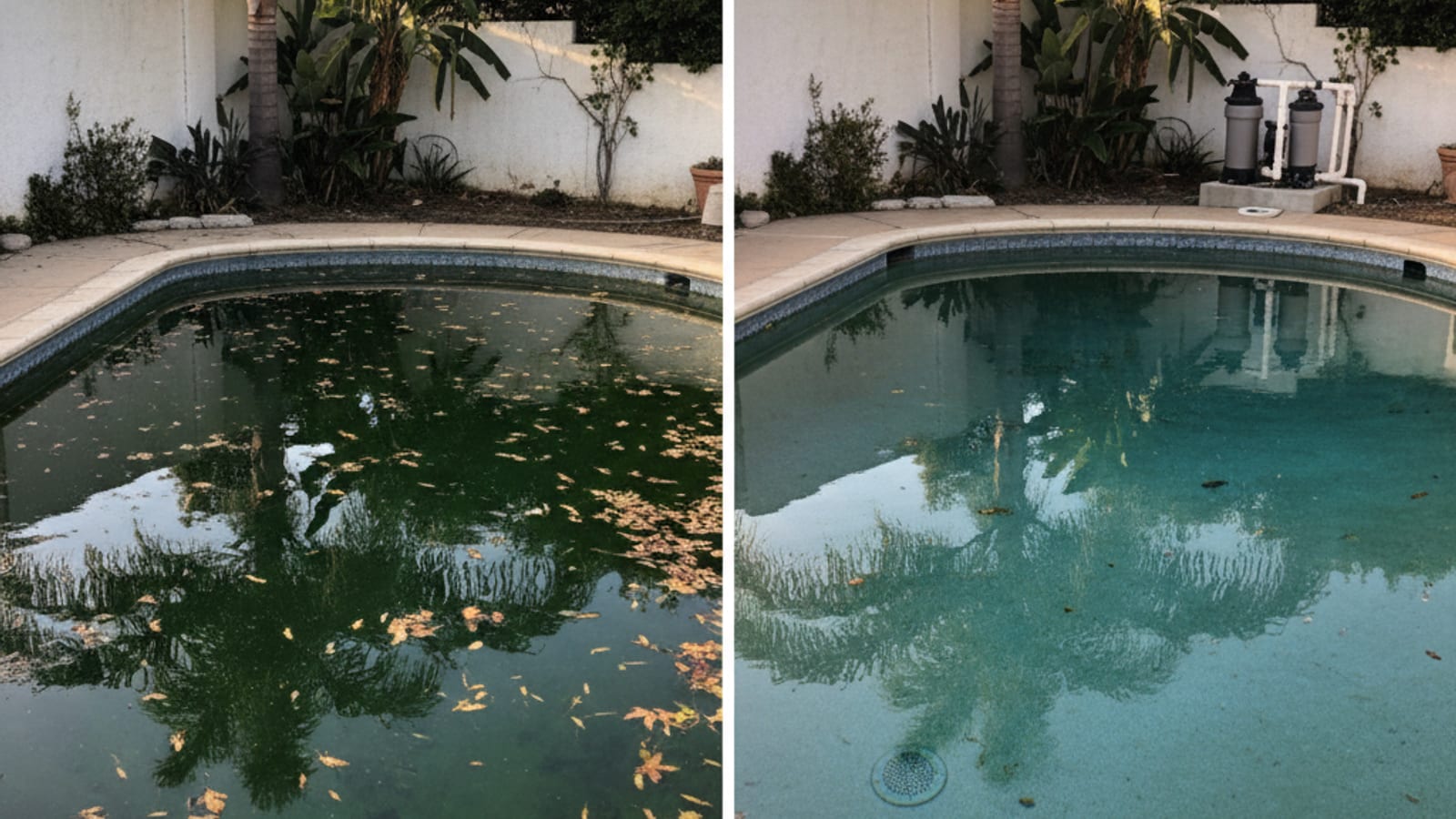
A green pool is almost always fixable in 24 to 48 hours. The problem is simple — algae bloomed because your sanitizer ran out, your filtration failed, or both — and the fix is mechanical: kill the algae, filter out the debris, balance the chemistry. Most DIY green pool treatments fail not because the approach was wrong, but because one of the four steps got skipped.
This guide covers exactly why pools turn green in San Diego, the three severity levels and what each costs to fix, and the full 48-hour recovery protocol we use on service calls across the county.
Why pools turn green: the three root causes
Algae spores are always in your pool water. They’re in the air, in dust, in pool tools, on swimsuits. As long as you have 1 to 3 ppm of free chlorine and the pump circulating, those spores die before they can multiply. When one of those two systems fails, the algae wins.
1. Sanitizer dropped to zero
The most common cause. Your chlorine ran out because:
- The floater is empty and you forgot to refill
- The salt cell stopped producing (scale on the plates, end of life, or disabled)
- A heavy-use weekend or pool party overwhelmed the sanitizer
- Heavy rain diluted the chemistry
- The stabilizer (CYA) is too low so UV destroyed the chlorine faster than you could add it
2. Filtration stopped
The pump died, a valve got closed, the filter clogged, or someone bumped the timer off. Water stops moving, algae bloom regardless of how much chlorine you dump in. Chlorine needs circulation to reach every part of the pool.
3. Chemistry was working against you
High CYA (over 80 ppm) makes chlorine nearly ineffective — you can run 5 ppm of free chlorine and still grow algae. High phosphates feed algae faster than your sanitizer can kill it. Low pH below 7.0 or high pH above 8.0 reduces chlorine’s killing power dramatically.
In East County and North County inland, the extremely hard water also scales salt cells and reduces chlorine output, creating a slow-motion green pool setup.
Green pool severity levels and what each costs
Not every green pool is the same. Here’s how we categorize them on service calls.
Light green (visible bottom, clear on test strips): Algae just started. Single heavy shock treatment, 48 hours of continuous filtration, one filter clean. Recovery time: 24 to 36 hours. DIY-feasible. Professional service: $250 to $350.
Medium green (can see steps but not drain, water cloudy): Established bloom with dead and live algae suspended in water. Double or triple shock, 48 to 72 hours of filtration, 2 to 3 filter cleans, clarifier to help the filter grab small particles. Recovery: 2 to 3 days. Professional: $350 to $500.
Dark swamp green (can’t see 6 inches down): Heavy algae bloom with significant organic debris. Often needs multiple shock cycles, floc treatment to drop debris to the bottom for vacuuming to waste, complete filter breakdown and cleaning. Recovery: 3 to 5 days. Professional: $500 to $800.
Black swamp (smells, can’t see at all, may have frogs/insects): Extended neglect, usually a few weeks minimum. Filter may be unsalvageable. Multiple treatment cycles. Sometimes a partial drain is required. Recovery: 5 to 10 days. Professional: $700 to $1,200.
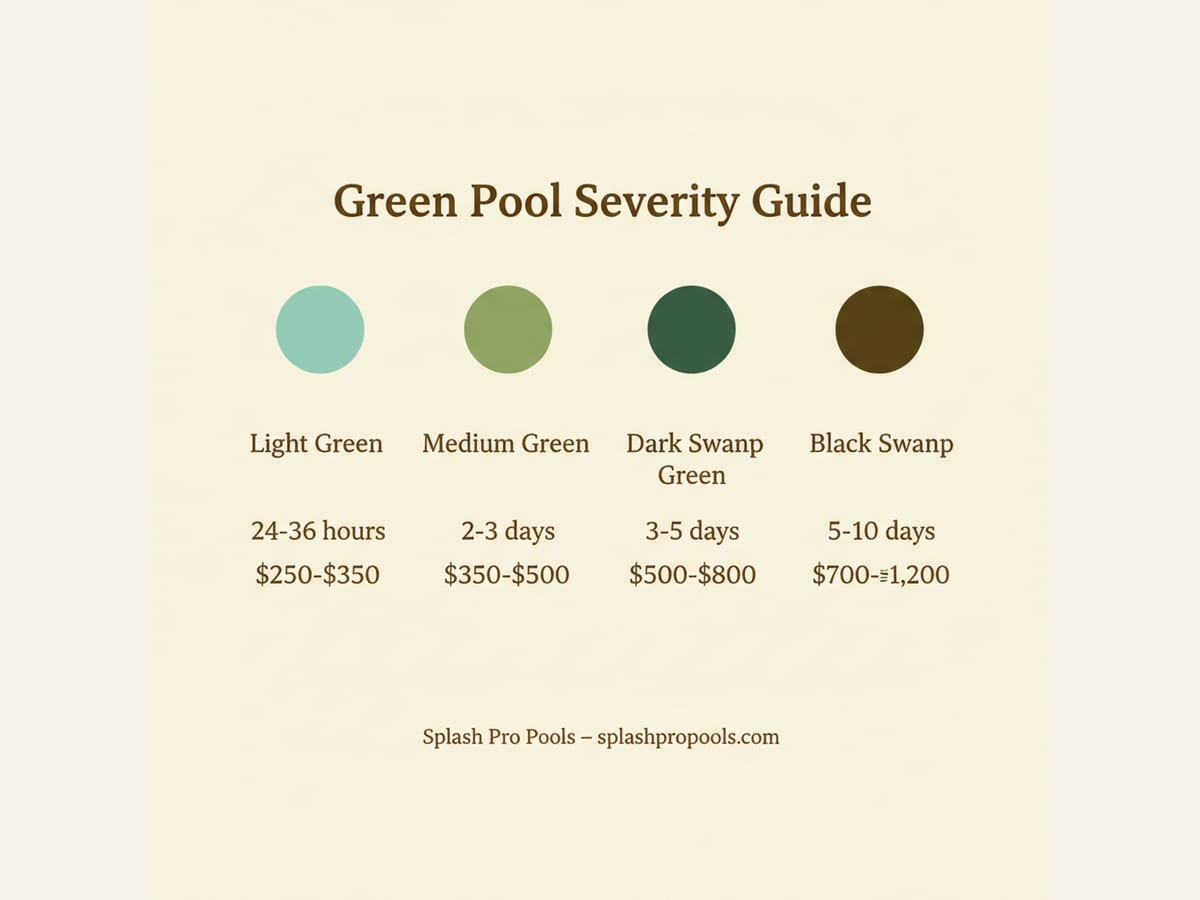 Green pool severity levels, typical recovery time, and professional treatment cost ranges.
The 48-hour green pool recovery protocol
Here’s what we actually do on a green pool recovery service call. Follow this sequence — skipping any step leads to reblooming within a week.
Step 1: Test and diagnose (first 30 minutes)
Before dumping chemicals, test the water. Key readings:
- Free chlorine (likely 0)
- pH (likely high or low)
- Total alkalinity
- Cyanuric acid (CYA / stabilizer)
- Phosphates (if you have test strips that measure)
If CYA is over 80 ppm, shock alone often won’t finish the algae. In severe cases, draining 30 to 50% of water and refilling is faster than trying to chemically fight through the stabilizer.
Step 2: Balance pH before shocking (first hour)
Shock works best at pH 7.2 to 7.4. High pH (common in San Diego) makes chlorine less effective. Add muriatic acid slowly to bring pH down before shocking. Wait 30 minutes with the pump running.
Step 3: Shock the pool aggressively (hour 2)
Calculate shock based on CYA using the FC/CYA ratio chart. For most residential pools, this means adding enough liquid chlorine to reach 20 to 30 ppm free chlorine. Household bleach works (unscented, 8.25% sodium hypochlorite). Don’t use dichlor or trichlor shock — they add more CYA to a pool that’s already struggling.
Step 4: Brush every surface (hour 3)
This is the step most DIY attempts skip. Algae forms a biofilm on pool surfaces that chlorine can’t penetrate unless you physically break it up. Brush the walls, steps, floor, tile line, and behind ladders. This alone accelerates recovery by 12 to 24 hours.
Step 5: Run the pump 24/7 and clean the filter (hours 4 through 48)
Filter runs non-stop. Check filter pressure every 4 to 6 hours — when it rises 10 PSI above clean baseline, clean the filter. A heavy green pool may require 3 or 4 filter cleanings in the first 24 hours. Each clean recovers flow and lets you trap more dead algae.
Step 6: Retest at 24 hours
If the water is turning blue-green or teal, you’re winning. Retest free chlorine — if it dropped below 5 ppm, add more shock. If pH drifted high again, re-acidify. Keep brushing daily until the water is clear.
Step 7: Final balance and stabilization (hours 36 to 48)
Once the water is clear:
- Bring free chlorine down to 1 to 3 ppm
- Adjust pH to 7.4 to 7.6
- Adjust alkalinity to 80 to 120 ppm
- Check and adjust calcium hardness and CYA as needed
- Consider a phosphate remover if algae keeps coming back
When DIY is not enough
Call a pro if:
- You’ve treated twice and the pool still isn’t clearing
- Equipment isn’t running (dead pump, closed valves, broken filter)
- CYA is over 100 ppm
- The pool smells
- You don’t have time to babysit the treatment for 48 hours
Green pool recovery is one of our most-requested services across San Diego County. For a severe swamp, we’ll tell you honestly whether chemical treatment alone can recover it or whether you need a partial drain.
Most of our green pool recoveries are running clear blue within 48 hours. Call (858) 400-8901 or see our green pool recovery service page for the full process.
Frequently asked questions
How fast can a green pool be cleared?
Most light-to-medium green pools are swimmable in 24 to 48 hours with proper shock treatment, brushing, and 24/7 filtration. Severely swamp-green pools with heavy organic debris or black algae can take 3 to 5 days. Extremely neglected pools with broken equipment may need a week of concentrated treatment.
Can I fix a green pool myself?
Yes, if the problem is caught early and you follow a complete recovery protocol — shock, brush, filter 24/7, clean filter as it loads, balance chemistry. DIY often fails on green pools that return within a week because people skip the brushing, filter cleaning, or phosphate management that prevents reblooms. If chemistry isn't back to balanced within 48 hours, call a pro.
Why does my pool keep turning green?
Chronic green pools usually mean one of three things: high cyanuric acid (CYA over 80 ppm) making your chlorine ineffective, phosphate contamination feeding algae despite shock treatments, or aging equipment not circulating enough water. Fix the root cause or you'll treat the same bloom every few weeks.
Do I need to drain my green pool?
Almost never. Even heavily green pools recover with aggressive chemical treatment and filtration. Draining is a last resort when total dissolved solids are extremely high, stabilizer is over 100 ppm, or there's physical debris you can't filter out. Draining in San Diego also wastes hundreds of gallons and requires following county wastewater rules.
Need professional help in San Diego County?
Splash Pro Pools provides every service in this post. Call for a free quote.