A note on scope: this is pool repair work, which sits outside what Splash Pro Pools does. Call (858) 400-6757 and we’ll match you with a vetted local pro who covers it.
Rancho Santa Fe pump repair is usually a seal kit at $250 to $400 or a high-end variable-speed motor at $700 to $1,200, versus $2,000 to $3,000 for a new pump. Santa Fe Irrigation District hardness of 10 to 14 grains per gallon chews the shaft seal. Splash matches the repair. Call (858) 400-6757.
Why Your RSF Pump Needs a Specialist
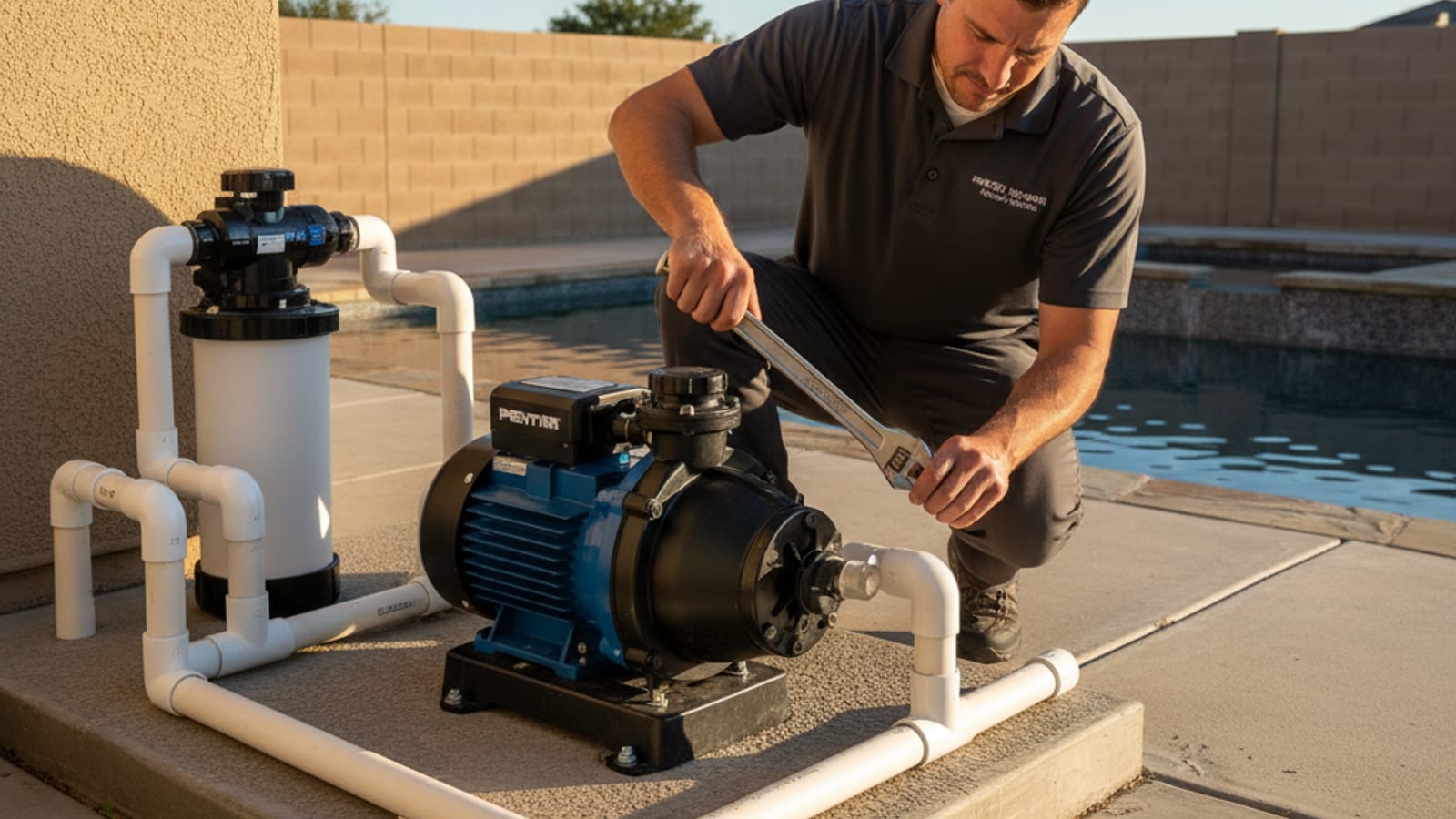
You wouldn’t take a Ferrari to a generic oil change shop. The same logic applies to the high-performance equipment running the pools in neighborhoods from The Covenant to The Crosby. Most of these properties aren’t using standard residential-grade pumps. They’re running commercial-grade workhorses like the Pentair IntelliFlo XF VSF or the Jandy JXi series, pumps designed to handle the immense hydraulic demands of your setup.
What kind of demands are we talking about?
- Elaborate Water Features: That beautiful infinity edge that overlooks the valley? It requires a pump with enough power (or a dedicated booster pump) to lift a massive volume of water several feet, fighting gravity the whole way. Waterfalls, deck jets, and in-floor cleaning systems add layers of hydraulic complexity. A weak or failing pump simply can’t keep up, leading to poor circulation and cloudy water.
- Sprawling Plumbing Runs: On a large estate, the equipment pad can be a hundred feet or more from the pool and spa. That distance creates a ton of friction loss in the pipes, which your pump has to overcome. We often see pumps that were undersized for the job, running at 100% capacity 24/7 just to keep up. That’s a recipe for premature failure.
- Complex Automation: Your system is probably controlled by a Pentair EasyTouch, Jandy AquaLink, or a similar automation panel. The pump doesn’t just turn on and off with a timer; it communicates directly with the control panel. It changes speeds based on whether you’re heating the spa, running the waterfall, or just filtering. A “pump failure” might not be the pump at all. It could be a faulty temperature sensor, a bad actuator on a valve, or a communication error in the control board. You need someone who can diagnose the entire system, not just the motor.
- Hard San Diego Water: This is the big one. The Santa Fe Irrigation District, which serves most of the area, reports water hardness between 10 and 14 grains per gallon (gpg). That’s officially “hard” to “very hard.” For your pool pump, this means a constant battle with calcium scale. Calcium carbonate builds up on everything, but it’s especially brutal on the pump’s impeller and shaft seal. This buildup throws the impeller off balance, which destroys the motor bearings. It also eats away at the shaft seal, causing those telltale drips and leaks that can fry the motor if ignored.
A general pool guy might just see a leaking pump and quote you for a new one. We see the calcium buildup from our local water and know that a proper seal replacement and a good cleaning of the impeller might get you several more years out of a very expensive piece of equipment.
Common Pump Problems We See Off Del Dios Highway
Day in and day out, pros in our network are on the road troubleshooting these exact systems. While every pool is unique, the symptoms of a failing pump tend to fall into a few familiar categories. Here’s what we see most often and what it usually means for a high-end system in Rancho Santa Fe.
The Loud Hum, Grind, or Screech
This is the most common call we get. A pump should be relatively quiet, especially a modern variable-speed model. If you hear a high-pitched screech or a low, grinding rumble, shut it down immediately.
- The Cause: 9 times out of 10, this is bad motor bearings. The bearings are small, sealed ball-bearing rings that allow the motor shaft to spin freely at thousands of RPMs. When the shaft seal fails (often due to hard water scale, as we mentioned), water gets past it and washes the grease out of the bearings. They rust, seize, and start screaming. Running the pump like this will quickly lead to total motor failure.
- Our Approach: This is a classic case for a pool pump repair in Rancho Santa Fe. For a high-end Pentair or Jandy pump, replacing the motor is often more cost-effective than replacing the entire unit. The pro can swap out the motor, install a new, heavy-duty seal kit, and check the impeller for calcium buildup. This single service can save you over a thousand dollars compared to a full pump replacement.
The Pump Won’t Prime (Or Keeps Losing Water)
You turn on the pump, and it just hums and gurgles, never catching and moving water. Or maybe it runs for a few minutes, then the water in the pump basket drops and it starts sucking air.
- The Cause: An air leak somewhere on the suction side of the system. On a simple pool, this is usually a bad pump lid o-ring. On an RSF estate pool, it’s more complicated. We often find the source is a failing seal on an automated valve (like the intake valve that switches between the skimmer and the main drain). The automation system can mask the problem, making it tricky to find. It could also be a cracked underground pipe, a less common but more serious issue.
- Our Approach: The process is systematic. The pro checks and lubricates every o-ring from the pump lid back, and can pressure test individual lines to pinpoint if the leak is coming from the skimmer, the main drain, or the spa suction line. For automated systems, the valves get manually cycled to see if one is letting in air. It takes patience and an understanding of complex plumbing.
Hard water can fake a dead pump
A waterfall that drops to a trickle with the pump at full RPM and a clean filter is often a scaled impeller, not a dead motor. Open the volute. If the fins are a white cake, an acid wash of the impeller plus a new seal kit can restore flow for a fraction of a new pump. Hard RSF water does that. Splash matches the tech. Call (858) 400-6757.
Repair or Replace? The $2,500 Question
When your high-end pump fails, you’re faced with a big decision. Do you invest in a repair, or is it time to bite the bullet and replace the whole thing? The answer depends on the age of the pump, the nature of the problem, and your long-term plans.
-
When to Repair: If your variable-speed pump is less than 5-7 years old and the problem is a bad motor, a failed seal, or a clogged impeller, a repair is almost always the smart move. The “wet end” of the pump, the durable plastic housing, can last for 15 years or more. A new motor and seal kit can give a 5-year-old pump a new lease on life for less than half the cost of a full replacement. This is the core of our Rancho Santa Fe pool service.
-
When to Replace: If you have an old, single-speed pump, it’s a no-brainer. California’s Title 20 regulations require any new or replacement filtration pump over a certain size to be a variable-speed model. The energy savings alone will pay for the new pump in just a couple of years. If your current variable-speed pump is over 8-10 years old and has had multiple repairs, its time is likely coming to an end. Technology also improves. A new Pentair IntelliFlo3 or Jandy VS FloPro is quieter and more efficient than a model from a decade ago, and often comes with better automation integration.
-
The DIY Warning: A lid o-ring is fair DIY. A motor swap on a 240-volt automated RSF pad is not. The new motor still has to talk to the control panel. A mismatch there leaves an expensive motor that will not run.
Your pool is a huge investment. Its pump is the engine that keeps that investment clean, safe, and beautiful. When it falters, don’t leave the diagnosis to chance. Get someone who understands the unique pressures, power, and problems of the pools right here in our neighborhood.
Frequently asked questions
How much does pool pump repair cost in Rancho Santa Fe?
It varies widely. A simple repair like a seal kit replacement might be $250-$400. A full motor replacement on a high-end Pentair or Jandy variable-speed pump typically runs from $700 to $1,200, which is still significantly less than the $2,000-$3,000 cost of a brand new pump.
My Pentair EasyTouch screen says "pump communication error." Is the pump broken?
Not necessarily. This common error means the automation panel can't "talk" to the pump. It could be a fried communication wire, a bad relay on the main circuit board, or an issue within the pump's own drive. It requires a technician who understands both the pump and the automation system to diagnose correctly.
Does the hard water from the Santa Fe Irrigation District really shorten my pump's life?
Absolutely. The high calcium content (10-14 gpg) builds up on the impeller and, more critically, the shaft seal. This scale chews up the seal, causing leaks that drip directly onto the motor's bearings, leading to rust, noise, and eventual seizure. Regular, proper water chemistry is your best defense.
Is it worth upgrading to a new variable-speed pump if my old one still works?
If you have an older single-speed pump, yes, 100%. The energy savings are massive, often between 50-80% on your pool's electricity usage. For the large, feature-heavy pools in Rancho Santa Fe, these savings can amount to hundreds of dollars a year, paying for the new pump in just a few seasons.
Need this done in San Diego County?
For repair and renovation work like this, we hand you to our trusted partner, Del Rancho Pools.