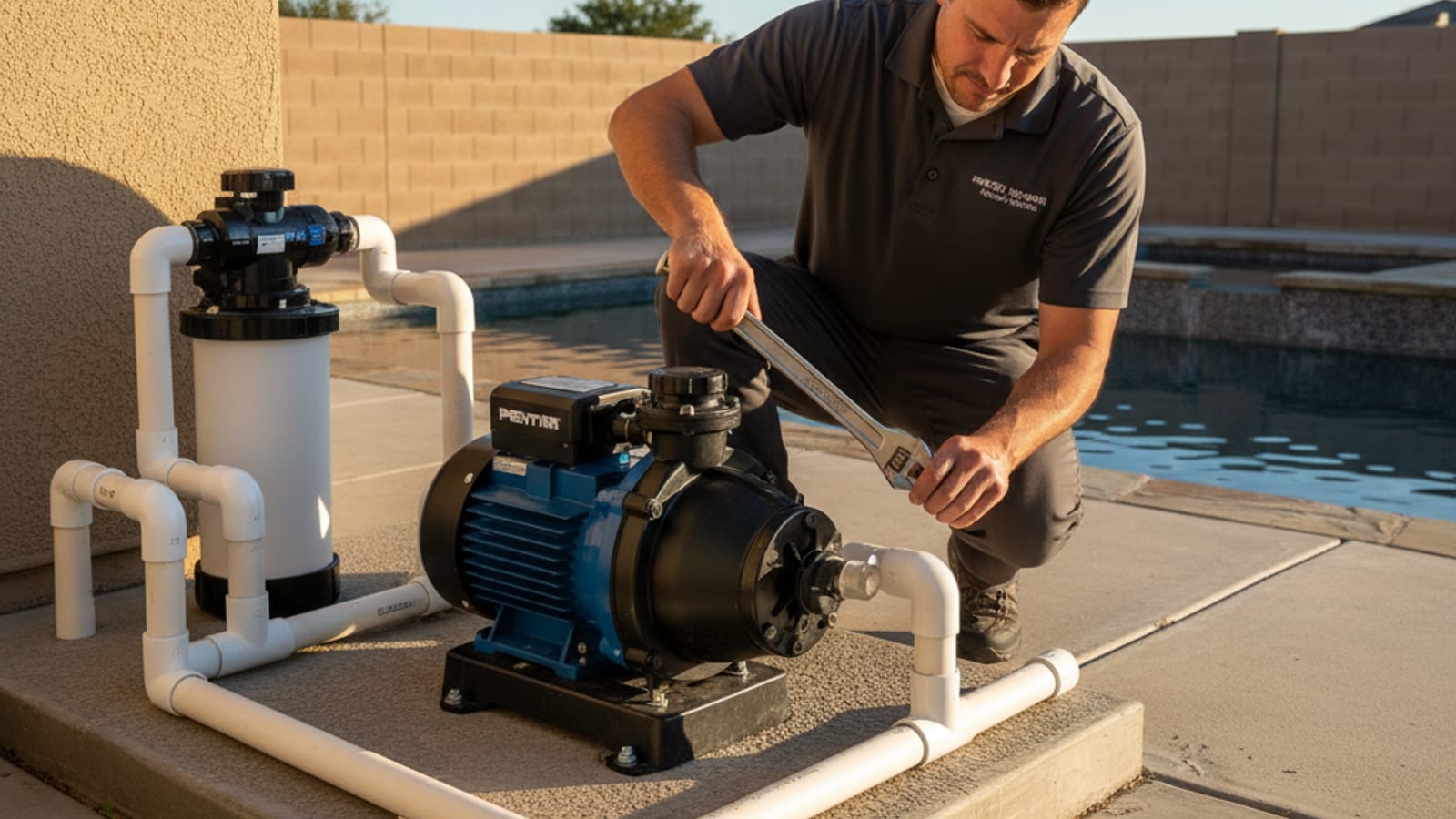
A pool pump that stops working is usually fixable — most failures come down to a dead capacitor, worn bearings, or a blown seal. If your pump is under eight years old, repair is almost always cheaper than replacement. If it’s a single-speed unit over ten years old, California Title 20 requires variable-speed replacement anyway, and the energy savings pay for the upgrade in two to three years under SDG&E’s time-of-use rates.
This guide walks through every common pool pump failure, how to diagnose it, what the repair actually costs, and when replacement is the smarter call.
How to tell if your pool pump needs repair
Pool pumps don’t usually fail silently. They give you warning signs for weeks or months before complete failure. Catching these early is the difference between a $150 repair and a full pump replacement.
Humming without starting. The motor hums but the shaft doesn’t spin. This is almost always a dead capacitor — a $120 to $180 fix including labor. If the motor has been humming for weeks without spinning, the windings may be damaged, pushing you toward a motor replacement.
Cycling off on thermal overload. The pump runs for 10 to 30 minutes, then shuts off for a while before restarting. Usually caused by restricted water flow (clogged impeller, closed valve, dirty filter) or a motor running too hot due to failing bearings. Check the filter pressure first — rising pressure points to the filter, not the pump.
Grinding or squealing noises. Bearings are failing. You have weeks to months before complete failure. A bearing replacement runs $200 to $300 in San Diego. Ignoring it leads to a seized motor and a full replacement.
Water leaking at the shaft seal. The seal between the wet end and the motor is worn. Small leaks mean water droplets under the motor. Bigger leaks ruin the motor by letting water into the bearings and windings. Seal replacement: $150 to $250.
Tripping the breaker. Either the motor is drawing too much current (failing windings) or there’s an electrical fault in the pump wiring. Check the wiring connections first, then have the motor amperage tested.
Losing prime. The pump runs but doesn’t move water. This is a suction-side air leak — we’ll cover the fix below.
The five most common pool pump repairs
Across the hundreds of pool pumps our San Diego County team services, these five repairs cover most service calls.
1. Capacitor replacement
Cost: $120 to $180 installed. The capacitor is a small cylindrical component attached to the motor that provides the initial electrical kick to start the motor spinning. They fail from age and heat — common in East County where temperatures regularly hit 100°F. If your pump hums but doesn’t start, this is the first thing to check. Replacement is a 15-minute job for someone comfortable with pool equipment wiring.
2. Bearing replacement
Cost: $200 to $300 installed. The motor shaft rides on two bearings. They wear out over 8 to 12 years of running, often earlier on pumps that run more hours per day. Signs: grinding, squealing, vibration. Once bearings start making noise, you have weeks before the motor seizes.
3. Shaft seal replacement
Cost: $150 to $250 installed. The mechanical seal keeps water from entering the motor. When it fails, water drips from the base of the pump. Seal replacement requires pulling the motor off the pump housing, so labor is the biggest cost. In San Diego’s hard water areas, scale on the seal face accelerates wear.
4. Impeller replacement
Cost: $180 to $320 installed depending on the impeller. The impeller is the part that actually moves water. Debris (hair, leaves, bobby pins) wrapped around it restricts flow. Scale buildup on the impeller in hard-water cities like El Cajon and San Marcos reduces efficiency over time. Occasionally the impeller cracks from freeze damage or physical debris.
5. Full motor replacement
Cost: $350 to $600 installed. When bearings, capacitor, and seal are all worn — or when the motor windings are burned out — a new motor is the right move. Motor-only replacements keep the existing wet end (housing, impeller, basket) which saves money. The whole job takes a pool technician about 90 minutes.
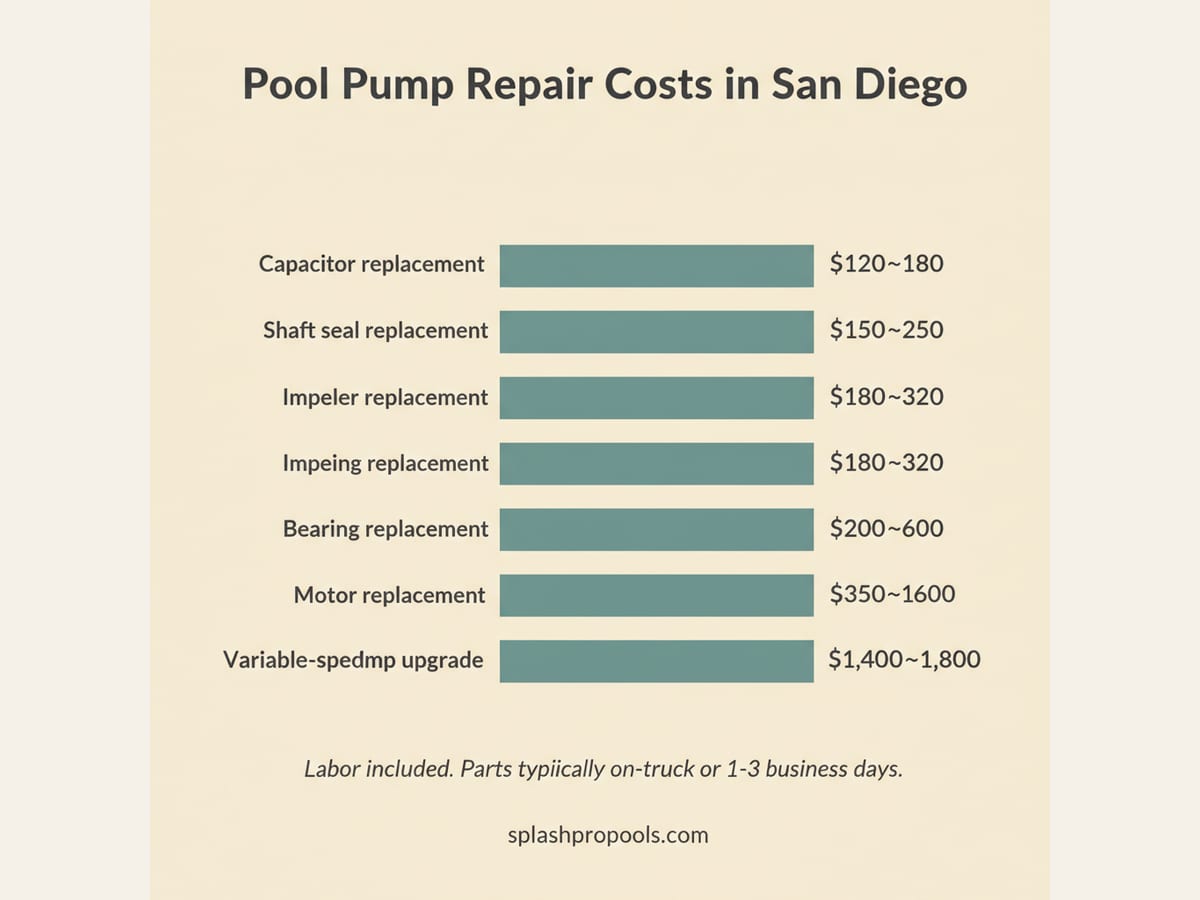 Typical pool pump repair costs in San Diego County, ranging from capacitor replacements to full variable-speed pump upgrades.
Diagnosing suction-side air leaks
A pool pump that loses prime has air entering somewhere between the skimmer and the pump. The air gets pulled in when the pump is running, which breaks the prime. Common spots to check, in order:
- Pump lid O-ring. Remove the lid, inspect the O-ring for cracks or brittleness, lubricate with pool-safe silicone lube, reseat. This alone fixes about 40% of priming issues.
- Drain plugs. Two small plugs on the pump housing for winterization. Threads strip, O-rings harden. Hand-tighten with fresh O-rings.
- Pump union fittings. The two plastic unions that attach PVC to the pump. The rubber gasket inside can fail. Pull the unions apart, inspect gaskets, replace if needed.
- PVC plumbing above the pump. Small cracks or poorly glued joints let air in. Look for water weeping from joints when the pump is off.
- Skimmer weir. Rare but possible — a cracked skimmer or loose skimmer basket can pull air when the water level drops.
The diagnostic trick: fill the pump basket, start the pump, and watch for bubbles in the clear pump lid as the water settles. Bubbles indicate air entering upstream of the pump. A steady stream of bubbles points to a significant leak. A slow burp every few seconds is usually the lid O-ring.
Variable-speed upgrade math for San Diego
If your pump is a single-speed unit over 10 years old, repair is usually the wrong answer. Here’s the math for a typical San Diego backyard pool.
A single-speed 1.5 HP pump running 8 hours a day pulls about 2.3 kW. At SDG&E’s on-peak TOU rate of roughly $0.55/kWh (afternoon/evening), running that pump during peak hours costs about $10 per day, or $300 per month. That’s why your summer pool electricity bill feels ridiculous.
A variable-speed pump running at 1,200 RPM for 12 hours moves the same water volume but only draws 0.3 kW. During SDG&E’s off-peak window (midnight to 6 AM and early morning), that’s about $0.20 per kWh. Total cost: about $0.72 per day, or $22 per month.
Savings: roughly $270 per month during peak season. A good variable-speed pump installed runs $1,400 to $1,800. Payback is usually 6 to 8 months in summer, 2 years overall. Plus California Title 20 requires variable-speed on pool pump replacements now anyway.
When to call a pro vs DIY
DIY-friendly pool pump fixes:
- Cleaning debris from the pump basket
- Replacing the lid O-ring
- Tightening drain plugs
- Replacing the capacitor (if you’re comfortable with electrical)
Call a pro for:
- Motor bearings, shaft seal, or impeller
- Full motor replacement
- Any work involving gas lines (if your heater is adjacent)
- Any leak where you can’t find the source in 30 minutes
- Any upgrade to variable-speed (requires programming and often SDG&E rebate paperwork)
Pool pump repair is one of the most common service calls we handle at Splash Pro Pools. If you’re in San Diego County and your pump is acting up, same-day diagnosis is typical. Most parts (capacitors, seals, bearings, common motors) are on our trucks. Less common parts ship in 1 to 3 business days.
Call (858) 400-8901 for a free diagnosis, or see our full pool repair service page for details.
Frequently asked questions
How do I know if my pool pump motor is bad?
The most common signs of a bad pool pump motor are humming without starting, cycling off on thermal overload, making grinding or squealing noises, leaking water at the shaft seal, or tripping the breaker. Age plus any of these symptoms usually means the motor bearings are failing or the capacitor has died. Many are repairable if the pump is under 8 years old.
How much does it cost to repair a pool pump?
Pool pump repairs in San Diego typically range from $120 for a capacitor replacement to $450 for a motor rebuild with new bearings and seal. A full motor replacement runs $350 to $600 installed. If the pump itself is cracked, a complete pump replacement is usually $750 to $1,400 depending on whether you're upgrading to variable speed.
Can I repair my pool pump myself?
Some repairs are homeowner-friendly: replacing the lid O-ring, pump basket, or drain plugs. Motor and seal work requires specific tools and knowledge of pool plumbing — improper assembly can cause leaks or burn out the new motor. If the pump is more than 10 years old, replacement with a variable-speed model typically pays for itself in 2 to 3 years.
Why is my pool pump losing prime?
A pool pump that loses prime usually has an air leak somewhere on the suction side (between the skimmer and pump). The most common causes are a bad lid O-ring, a leaking pump drain plug, a cracked pump housing, or a leak at a union fitting. Fill the pump basket, start the pump, and watch for bubbles in the pump basket — they indicate where air is entering.
Need professional help in San Diego County?
Splash Pro Pools provides every service in this post. Call for a free quote.