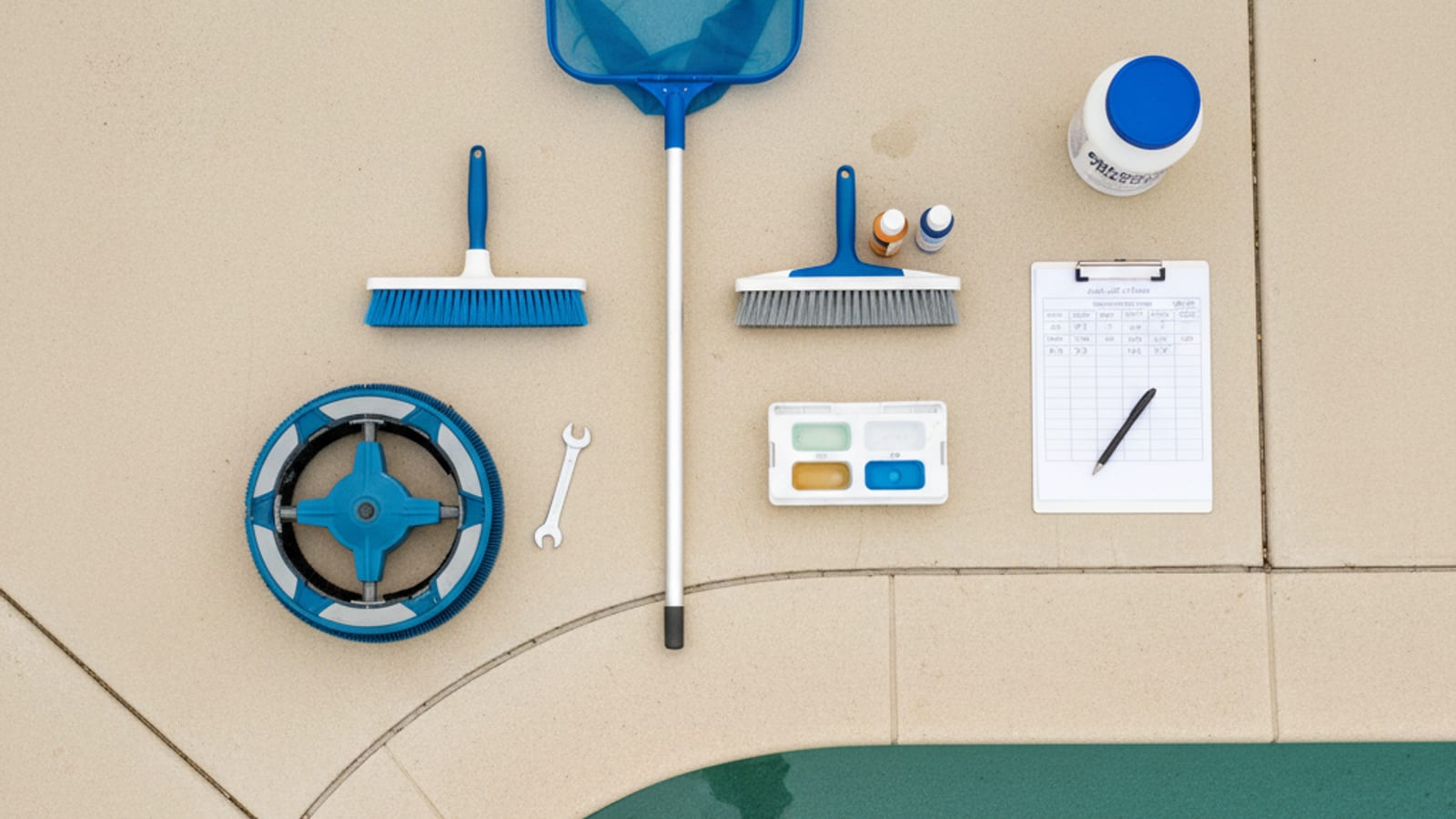
A pool is a system. It needs daily attention, weekly chemistry work, monthly deep cleaning, and seasonal inspections. Miss any of these layers and the pool punishes you — green water, scale buildup, equipment failure, or all three. This guide breaks down exactly what to do at each interval, with time estimates and what’s actually critical versus optional. Use it as a DIY checklist or as a way to understand what a professional pool service should be doing.
Daily checklist (2 minutes)
These aren’t tasks so much as glances. Walk past the pool and check:
- Water level. Should be at the middle of the skimmer opening. Too low and the pump loses prime, potentially burning out the motor. Top off with the auto-fill or a garden hose if needed.
- Water clarity. Can you see the bottom clearly? If not, something shifted overnight — chemistry, debris, or equipment.
- Equipment noise. Listen for the pump. Normal hum = fine. Grinding, squealing, or silence = problem.
- Obvious debris. Leaves or debris floating? Skim them out now or they sink and rot, consuming chlorine.
If anything looks off, add a check to your weekend list. Most small problems can wait 24-48 hours without becoming big ones — but persistent cloudiness or pump noise should get attention within a day or two.
Weekly checklist (30 to 60 minutes)
This is the core of pool maintenance. Skip this and chemistry drifts, algae blooms, scale forms.
Physical cleaning (15 to 20 minutes)
- Skim the surface with a leaf net
- Empty skimmer basket(s)
- Empty pump basket
- Brush the walls, floor, and steps — this is the most-skipped task and the one that prevents algae biofilm
- Vacuum the floor (or run the automatic cleaner)
- Hose off pool deck debris away from the pool (not into it)
Chemistry testing and adjustment (15 to 20 minutes)
- Test: free chlorine, pH, total alkalinity
- Target ranges:
- Free chlorine: 1 to 3 ppm (chlorine pool), 1 to 2 ppm (salt pool)
- pH: 7.4 to 7.6
- Total alkalinity: 80 to 120 ppm
- Adjust as needed. For San Diego’s alkaline water, you’ll add muriatic acid most weeks to keep pH down.
- Test CYA monthly (not weekly). Target 30 to 50 (chlorine), 60 to 80 (salt).
Equipment check (5 to 10 minutes)
- Check filter pressure. Note baseline after cleaning. Clean filter when pressure rises 8 to 12 PSI above baseline.
- Look at the pump — leaks, unusual noise, proper priming.
- Inspect heater if you use one — error codes, visible issues.
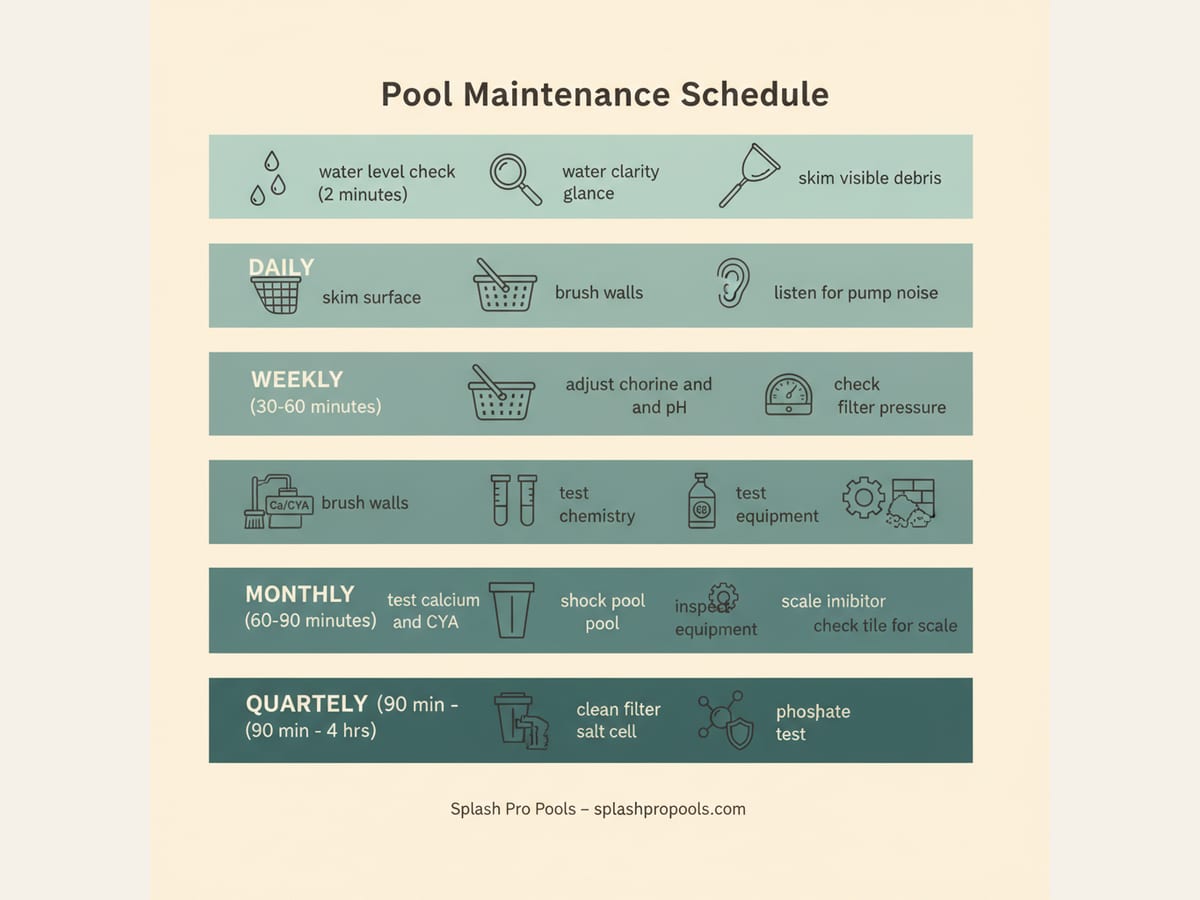 Full pool maintenance schedule broken into daily, weekly, monthly, and quarterly tasks.
Monthly checklist (60 to 90 minutes)
Once a month, do the weekly checklist plus:
- Deep chemistry test. Test calcium hardness, cyanuric acid (CYA), and total dissolved solids. San Diego pools often need more aggressive calcium management, especially in hard-water areas like El Cajon and San Marcos. TDS should stay under 2,500 ppm in chlorine pools, under 5,000 ppm in salt pools.
- Clean the filter. Cartridge: rinse thoroughly. Sand: backwash and rinse. DE: backwash and recharge with new DE powder. See our pool filter cleaning guide for detailed steps.
- Deep-clean skimmer weirs and baskets. Remove mineral deposits and biofilm.
- Inspect tile for calcium scale. San Diego pools build scale fast. Light buildup can be removed with pumice or scale-remover products; heavy scale needs professional bead blasting.
- Shock the pool. Routine monthly shock prevents chloramine buildup and maintains sanitizer effectiveness. See the shocking guide for correct doses based on your CYA.
- Check pool lights. LED lights should come on consistently. Any flicker or delay means the driver is aging.
- Inspect visible plumbing. Look for weeping joints, scale buildup at fittings, damaged unions.
Quarterly checklist (90 minutes to 2 hours)
Every 3 months, do monthly plus:
- Deep filter clean. Cartridge: soak overnight in filter cleaner to remove oils and fine debris. DE: teardown grids for inspection. Sand: check sand level and quality.
- Clean salt cell (if you have one). Remove, inspect plates, soak in diluted muriatic acid (1:10 ratio) for 15 minutes, rinse, reinstall. Scale on cell plates is the #1 cause of reduced chlorine output.
- Scale inhibitor treatment. Especially important in hard-water cities. Add scale inhibitor to slow calcium buildup on tile and equipment.
- Phosphate test. If under 300 ppb, no action needed. If higher, treat with phosphate remover.
- Visual equipment inspection. Look for minor issues before they become major: small leaks at equipment pad, corrosion on metal parts, UV degradation on exposed plastic components.
Seasonal tasks
Spring (March - April)
- Uncover pool if covered
- Inspect for winter damage on coping, tile, equipment
- Ramp up chlorine — warmer water increases demand
- Raise water temperature if using heater
- Open any closed valves for summer pool operation
- Schedule professional inspection if you haven’t had one in 2+ years
Summer (May - September)
- Shock more aggressively — every week in peak heat
- Run pump longer hours to handle increased bather load
- Monitor calcium more closely — hot water and evaporation concentrate calcium fast
- Check filter pressure more frequently
- Refill water more often (evaporation runs 1/4 inch per day in peak summer)
Fall (October - November)
- Clean pool thoroughly before heavy leaf drop
- Service heater before winter use
- Test and adjust chemistry before temperature drop
- In mountain areas and backcountry: prepare for freeze protection
- Schedule tile cleaning if calcium has accumulated
- Add phosphate remover before winter to prevent spring algae
Winter (December - February)
- Pump runs fewer hours daily (but still at least 4 to 6 hours)
- Sanitizer demand is lower — watch for overdosing
- Monitor for freeze conditions overnight; run pump continuously if temperature drops below 40°F
- Clean debris after Santa Ana events — ash and debris load pools heavily during winter wind events
Annual deep-maintenance items
Once a year, regardless of schedule:
- Professional equipment inspection
- Filter grid replacement check (DE filters) or sand replacement check (5-7 year cycle)
- Pump seal and bearing inspection — catches failures before they happen
- Safety equipment check: drain covers, VGB compliance, pool fence and gate condition
- Tile cleaning (bead blasting) if calcium has accumulated
- Resurfacing assessment every 10 years or when plaster shows wear
When DIY becomes not worth it
A reasonable DIY pool owner spends 45 to 75 minutes a week plus 90 minutes monthly. That’s 5 to 7 hours per month of pool work. If you value your time at $30/hour, DIY is “costing” $150 to $210/month in labor alone — before chemicals.
Professional weekly service in San Diego starts at $199/month and includes chemicals. For homeowners who value the time, travel, or just don’t want to think about pool chemistry, professional service is often cheaper than DIY when you account for the time cost. See our weekly pool cleaning service page for what’s included.
Even if you stay DIY, having a professional walk through your pool once or twice a year (inspections, tile cleaning, filter deep cleans) often catches issues before they become expensive repairs. Call (858) 400-8901 for a free assessment anywhere in San Diego County.
Frequently asked questions
How often should I maintain my pool?
A well-maintained pool requires daily visual checks (2 minutes), weekly chemistry and cleaning (30 to 60 minutes), monthly equipment inspection and deep clean (60 to 90 minutes), and quarterly or seasonal tasks like filter deep cleans, equipment inspections, and tile cleaning. Skipping weekly service almost always creates bigger problems that cost more to fix than the service saves.
What does weekly pool service include?
Standard weekly pool service covers: skimming surface debris, brushing walls and steps, vacuuming the floor, emptying skimmer and pump baskets, testing chemistry (pH, chlorine, alkalinity), adding chemicals as needed, inspecting pump and filter pressure, and leaving a service log with readings and observations. Full professional service typically takes 25 to 40 minutes for a standard residential pool.
Can I maintain my pool myself?
Yes, if you have 30 to 60 minutes per week and a test kit. DIY pool maintenance works for homeowners who are consistent and willing to learn the chemistry. The failure mode is usually skipped weeks that snowball into green pools or equipment problems. If you travel, have a busy schedule, or just don't enjoy the work, professional weekly service runs $199/month and up in San Diego.
When should I professionally service my pool?
Schedule professional service if: you're a new pool owner and don't know the chemistry yet, you've had more than one green pool in a year, your pool equipment is 10+ years old and showing issues, you have a complex setup with automation or water features, or you simply want the time back. Most San Diego homeowners who try DIY pool care for a year end up hiring weekly service.
Need professional help in San Diego County?
Splash Pro Pools provides every service in this post. Call for a free quote.