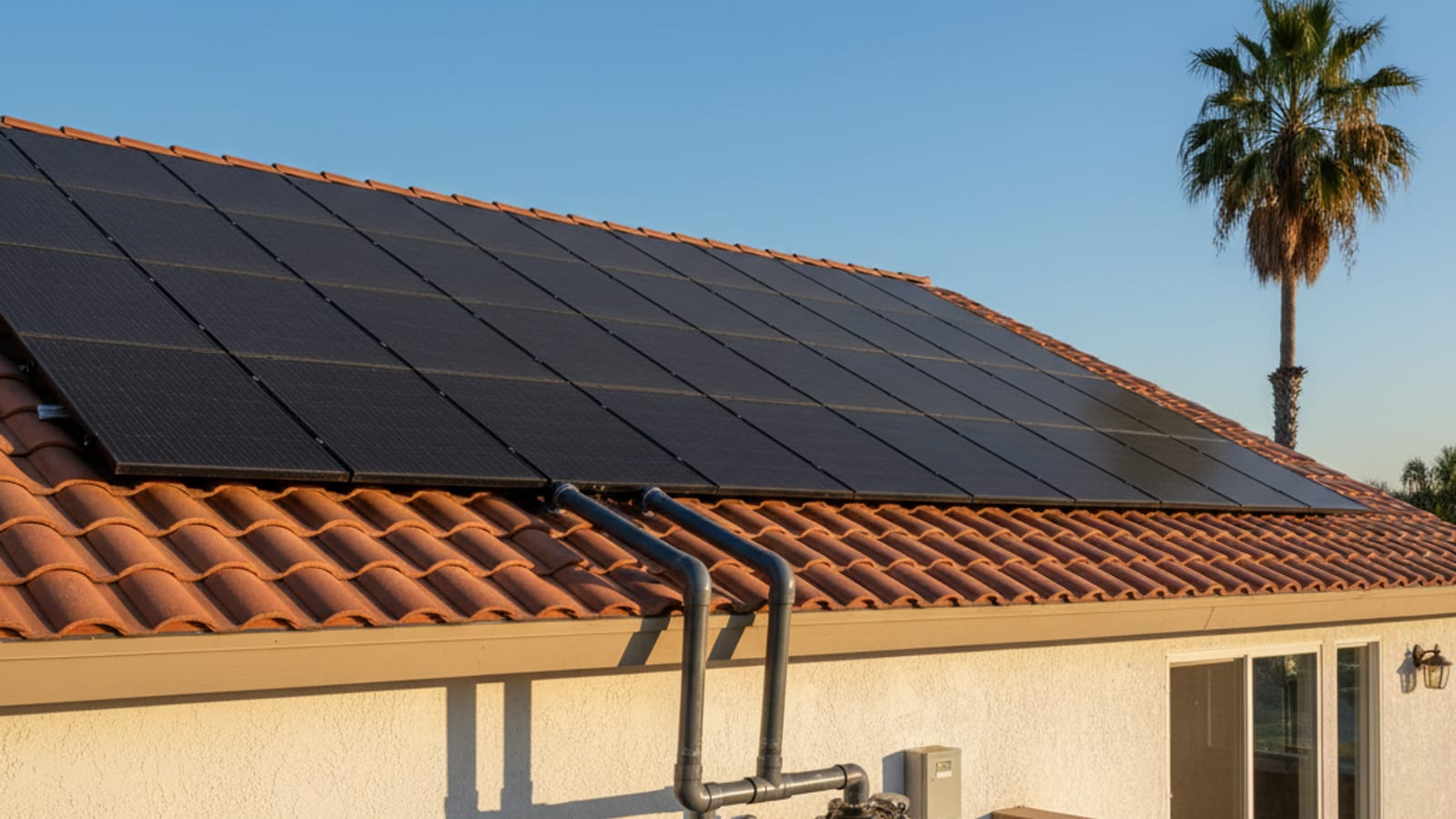
A solar pool heater in San Diego is one of the best energy investments a pool owner can make — if your roof works for it. With our climate, most pools can stay comfortable April through October on solar alone, and the system usually pays for itself in 4 to 7 years versus running a gas heater. This guide covers what solar pool heating actually costs in San Diego, how it compares to gas and electric heat pumps, when it’s the right choice, and when it’s not.
How solar pool heating works
A solar pool heater is simple: black polymer panels on your roof, connected to your pool plumbing. Your pool pump pushes water through the panels, where the sun heats it, then the heated water flows back into the pool. A temperature sensor and automatic valve turn the system on when the roof is hotter than the pool and off when it’s not.
There’s no fuel cost — you’re using your existing pool pump to move water and the sun to heat it. Your only electricity cost is the small extra pump load from pushing water to the roof.
What it costs in San Diego
Equipment (DIY or supplied): $2,000 to $4,000 for panels, controller, valves, and plumbing components for a typical residential pool.
Installation: $2,000 to $4,500 depending on roof complexity, number of panels, and plumbing runs. Two-story homes and tile roofs add cost.
Total installed: $4,500 to $8,500 for a residential pool in San Diego.
Sizing rule of thumb: Solar panel area should be 50% to 100% of the pool’s surface area. For a 20x40 foot pool (800 sq ft), that’s 400 to 800 sq ft of panels. Most San Diego backyard pools get panels covering a big portion of a south-facing roof.
Federal and state incentives: The federal Residential Clean Energy Credit (30% through 2032) can offset installation costs significantly. California may offer additional rebates through specific utilities. Check with SDG&E for current programs — they change annually.
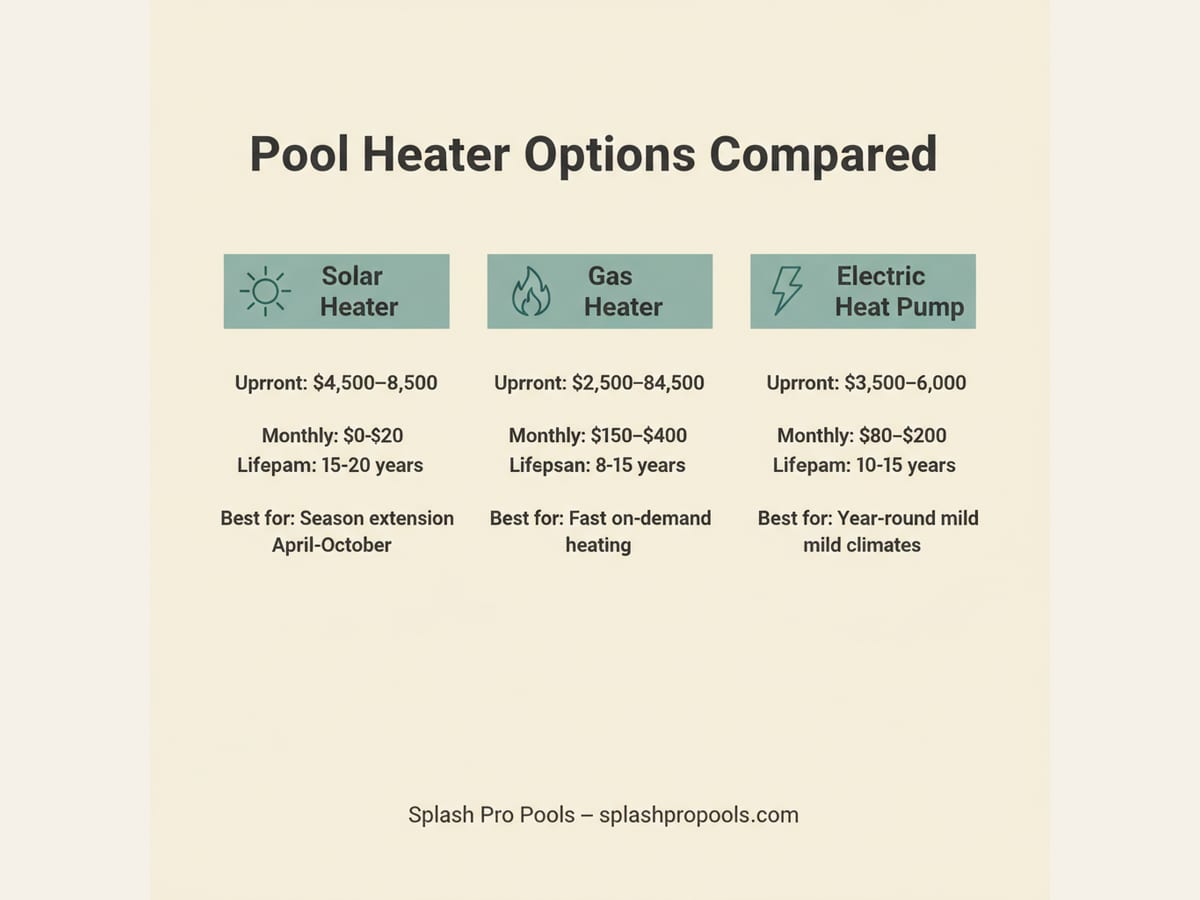 Upfront and ongoing costs of the three main pool heater types in San Diego.
Solar vs gas vs electric heat pump
Gas heater (natural gas or propane): Heats fast, works in any weather, costs more to run. A typical gas heater on a 20,000-gallon pool costs $150 to $400 per month to maintain 80°F through San Diego winter. Upfront cost: $2,500 to $4,500 installed.
Electric heat pump: More efficient than gas but slower to heat, doesn’t work below 50°F air temp. Typical operating cost: $80 to $200 per month to maintain 80°F. Upfront: $3,500 to $6,000 installed.
Solar heater: No fuel cost, works when the sun shines. Extends swim season April through October easily, gets marginal heat December through February. Upfront: $4,500 to $8,500 installed.
Hybrid (solar + gas or heat pump backup): The most common setup for homeowners who want year-round 80°F. Solar does the heavy lifting 8 months of the year, backup fills the gap in winter and during cold snaps. Upfront: $6,500 to $12,000 installed.
When solar is the right choice
You have a clear south-facing roof with minimal shade. Solar needs direct sun. Roofs with shade from neighboring trees, chimneys, or buildings underperform dramatically.
Your pool is used primarily April through October. Solar excels in our warmer months. If you only swim spring through early fall, solar alone is usually enough.
You plan to stay in the house 5+ years. Payback period versus gas is 4 to 7 years. Shorter stays often don’t recoup the investment, though solar does add some resale value.
Your gas heater bills are over $200/month in season. If you’re running a gas heater hard, solar’s operating cost savings alone pay for the system in 3 to 5 years.
When solar is not worth it
Your roof doesn’t work. North-facing, heavy shade, complex multi-pitch, or no clear run for plumbing. Ground-mounted solar is possible but requires significant yard space.
You need fast heating on demand. Solar is slow — it takes hours to raise pool temperature by 5°F. Gas or heat pumps are better if you’re heating for a planned event.
You want consistent year-round 80°F. San Diego winter solar output doesn’t keep a pool at 80°F. You need backup or you’ll have cold water December through February.
Your existing pool pump can’t handle the added head pressure. Older single-speed pumps sometimes lack the pressure to push water up to the roof. Budget for a variable-speed pump upgrade if your existing pump is marginal.
Installation considerations for San Diego homes
Roof type. Composition shingle is easiest. Tile roofs require careful mounting that doesn’t crack tiles. Flat roofs can work with ballasted mounts. Ask your installer about warranty impact on the roof.
Plumbing runs. Shorter runs are better — less heat loss, lower pump load. Panels adjacent to the equipment pad on a single-story home are ideal.
HOA approval. Most San Diego HOAs allow solar pool heating under California solar access laws, but aesthetic rules may restrict panel placement. Get approval documented before starting.
Freeze protection. Rare in San Diego but real for Alpine, Julian, and Pine Valley at elevation. System should include automatic drain-down on temperatures below 40°F.
Roof penetrations. Professional installers use proper flashing. DIY roof penetrations cause leaks. Not worth the savings.
Maintenance expectations
Solar pool heaters are low-maintenance but not maintenance-free.
- Inspect panels annually for damage, UV degradation, or pest infestation (rodents sometimes chew plumbing connectors).
- Replace controller every 8 to 10 years.
- Inspect isolation valves and check valves every 2 years.
- Watch for leaks at roof connections during heavy rain.
- Winterize in rare freeze conditions by manually draining panels.
Unlike gas heaters, there are no combustion components to service, no ignition modules, no pilot lights, no annual gas line inspections. The simplicity is a big part of the value.
The payback math
For a typical San Diego residential pool using a gas heater currently:
- Gas heater operating cost: $200/month × 7 months peak use = $1,400/year
- Solar operating cost: $20/month pump-only adder = $240/year
- Annual savings: $1,160/year
- Solar system cost: $6,500 installed
- Federal tax credit (30%): -$1,950
- Net cost: $4,550
- Simple payback: 3.9 years
After year 4, it’s pure savings for the 10 to 15 years of remaining system life. Total 15-year savings: roughly $13,000 over running gas.
Combining solar with existing equipment
If you already have a gas heater or heat pump, solar integrates cleanly. The solar controller takes over when the roof is hot enough; your existing backup kicks in when solar alone can’t reach the target temperature. Most homeowners set the controller to prefer solar heating and only enable backup for cold snaps or scheduled events.
Want solar pool heating installed in San Diego? Call (858) 400-8901 for a free site evaluation. We assess roof suitability, pool circulation, existing equipment compatibility, and walk you through incentives. See our full pool equipment service page for details on all heater types we install.
Frequently asked questions
How much does a solar pool heater cost in San Diego?
A complete solar pool heater system in San Diego typically costs $4,500 to $8,500 installed for a residential pool. Pricing depends on roof area needed, number of panels, existing pool equipment compatibility, and whether your existing pump can handle the additional head pressure. Federal tax credits and local incentives can reduce net cost by 20 to 30%.
How long does a solar pool heater last?
Quality solar pool heater panels last 15 to 20 years in San Diego with proper maintenance. The polymer panels are UV-stabilized and handle the climate well. Main maintenance items are checking for freeze damage after rare cold snaps, inspecting connections, and occasionally replacing the controller (typically every 8 to 10 years).
Is solar pool heating worth it in San Diego?
For pools used year-round or pools with existing gas heater bills over $200/month, solar almost always pays off within 4 to 7 years. Solar performs best on South-facing roofs with minimal shade and at least 50% of the pool's surface area in panels. It extends the swim season by 2 to 4 months, often making year-round use practical without gas backup.
Do solar pool heaters work in winter?
Solar pool heaters work in San Diego winter, but output drops significantly. A solar-only pool typically stays 65 to 75°F in December and January, which is too cold for most people. Most San Diego homeowners pair solar with a small gas or electric backup heater for December through February, or use solar to extend the season March through November.
Need professional help in San Diego County?
Splash Pro Pools provides every service in this post. Call for a free quote.