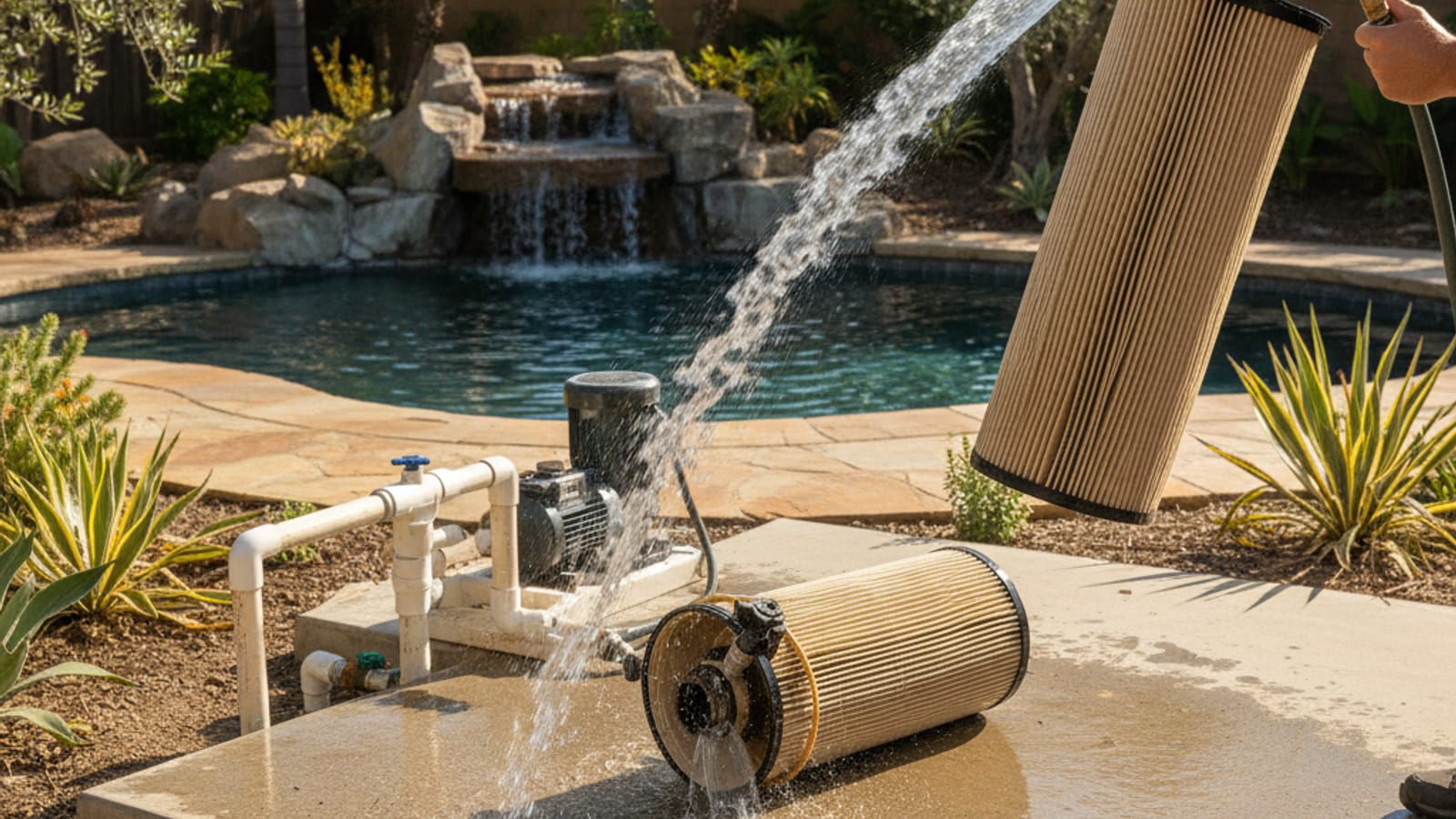
Your pool filter is the difference between crystal clear water and perpetually cloudy. It catches everything the skimmer misses, and how well it works depends almost entirely on how often you clean it. This guide covers the three filter types you’ll find on San Diego pools, when to clean each one, the step-by-step cleaning process, and how to tell when cleaning isn’t enough and you need new media or a new element.
The three pool filter types
Cartridge filters use a pleated element made of polyester fabric. They catch particles down to 10 to 20 microns and are the most common filter on newer San Diego residential pools. They’re easy to clean (rinse with a hose), don’t require DE powder, and handle hard water better than sand. Downside: they eventually wear out and need replacement every 3 to 5 years.
DE (diatomaceous earth) filters use grids coated with DE powder that catches particles down to 2 to 5 microns — the finest filtration of the three. They’re what you want if crystal-clear water is the priority. Downside: DE powder has to be added after every backwash, grids need annual teardown and cleaning, and DE is a pain to handle.
Sand filters use a bed of silica sand that catches particles down to 20 to 40 microns. Simple to operate, cheap to maintain, forgiving. Downside: the least-fine filtration of the three, and sand needs full replacement every 5 to 7 years.
Most newer residential pools in Carlsbad, San Marcos, and Poway developments use cartridge filters. Older pools and some commercial installations still have DE or sand. Each requires a different cleaning approach.
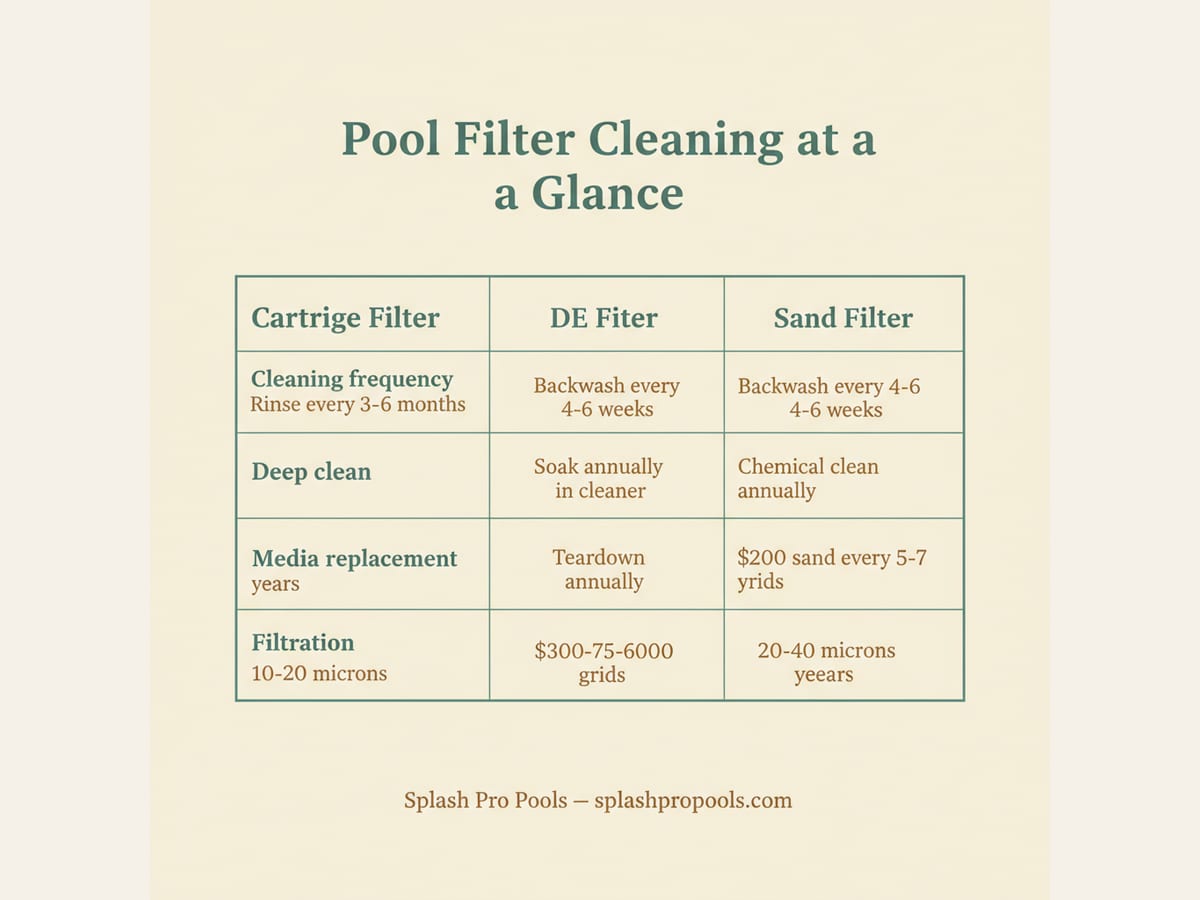 Cleaning frequency, typical lifespan, and replacement costs for the three main pool filter types.
How to clean a cartridge filter
Tools needed: garden hose, flathead screwdriver or wrench for the band clamp, filter cleaner (enzyme-based) for deep cleans.
Monthly rinse (skip if filter pressure hasn’t risen):
- Turn off the pump and switch off the breaker at the sub-panel.
- Release the air relief valve on top of the filter.
- Unscrew the band clamp or wing nut holding the filter lid on.
- Lift the top housing straight up off the cartridge.
- Remove the cartridge and rinse with a garden hose from the top down, getting water into every pleat. Work your way around the cartridge.
- Inspect pleats for tears or collapsed sections.
- Reassemble, restart the pump, bleed air from the relief valve.
Annual deep clean (required 1-2x per year): Do the above, then soak the cartridge in filter cleaner overnight. Oils, sunscreen, and body residue build up on pleats and a simple rinse doesn’t remove them. Enzyme cleaners (like BioGuard Kleen It or Spa Marvel) break these down. Rinse thoroughly and reassemble.
When to replace a cartridge: pleats are torn, fabric is collapsed, or filter pressure rises within a week after cleaning. Standard residential cartridges run $30 to $75. Premium large-capacity cartridges (Pentair Clean & Clear, Hayward SwimClear) run $150 to $300.
How to backwash a sand filter
Sand filters are cleaned by reversing the water flow — water enters from the top, pushes debris out the waste line. Tools needed: backwash hose (usually already connected), filter cleaner for chemical cleaning.
Backwash process:
- Turn off the pump.
- Move the multiport valve handle to “Backwash.”
- Extend the backwash hose to a drain or approved disposal area.
- Start the pump. Run for 2 to 3 minutes until the water in the sight glass runs clear.
- Turn off the pump.
- Move the valve to “Rinse.”
- Start the pump, run for 30 to 60 seconds.
- Turn off, move valve back to “Filter,” restart.
Do this every 4 to 6 weeks, or whenever pressure rises 8 to 10 PSI above clean baseline.
Annual chemical clean for sand filters: Sand eventually gets coated with oil and mineral deposits that backwashing doesn’t remove. Once a year, add a filter cleaner chemical to the skimmer, circulate for 15 minutes, shut off the pump for 8 to 12 hours, then backwash. In East County hard water areas, this is especially important.
When to replace sand: Every 5 to 7 years. Sand wears smooth over time and stops filtering effectively. Sand replacement runs $200 to $400 installed depending on filter size.
How to clean a DE filter
DE filters are the most complex to clean properly. Tools needed: backwash hose, DE powder, filter cleaner or muriatic acid for annual cleaning, hose.
Backwash and recharge (every 4 to 6 weeks):
- Backwash the same as a sand filter (3 minutes to clear, 30 seconds rinse).
- Calculate required DE powder — typically 1 pound per 10 sq ft of filter area (check your manual).
- Mix DE with water in a bucket to make a slurry.
- With the pump running and filter set to filter mode, slowly pour the slurry into the skimmer.
- The DE coats the grids through normal circulation.
Annual full teardown (typically late spring):
- Turn off pump, release pressure.
- Open the filter housing.
- Remove the grid assembly (DE grids are the fabric-covered frames inside).
- Rinse each grid thoroughly with a hose from the outside.
- Inspect grids for tears. Replace torn grids (individual grids are $40 to $80, full grid sets are $300 to $600).
- Soak grids in a diluted filter cleaner or muriatic acid solution (1 part acid to 10 parts water) if you have heavy calcium or oil buildup.
- Rinse thoroughly, reassemble, recharge with fresh DE.
Filter pressure and when to clean
The clearest signal that it’s time to clean your filter is pressure. Note the pressure gauge reading when the filter is freshly cleaned — that’s your baseline. When pressure rises 8 to 12 PSI above baseline, clean the filter.
High pressure does three bad things:
- Reduces water circulation, which lets algae grow and raises chemical demand
- Strains your pump, shortening motor life
- Makes heaters cycle off on pressure switches
If filter pressure rises quickly after cleaning (within a week of weekly use), the media is exhausted:
- Cartridge: replace the cartridge
- Sand: replace the sand
- DE: rebuild the grids
San Diego-specific filter issues
Hard water scale in cartridges: In cities like El Cajon and San Marcos, calcium scale embeds in cartridge pleats. Standard rinses don’t remove it. Annual acid washing (1:10 acid-to-water, quick soak, thorough rinse) restores flow. If acid washing doesn’t restore baseline pressure, the pleats are too scaled to recover — time to replace.
Salt water pool filters: Salt systems produce very fine chlorine that’s harder on cartridge fabric. Expect cartridges to wear out on the 3-year end of the 3-to-5-year range.
Post-fire filter stress: During Santa Ana events or fire season, ash and particulates hit pool filters hard. Pressure can rise 10 PSI in a day. Clean immediately after ash events — letting it sit compounds the problem.
When to call a pro
Call a pro for:
- DE filter annual teardown (unless you’ve done one before)
- Replacing DE grids (requires specific parts)
- Sand replacement
- Any filter with a leaking housing, bad multiport valve, or cracked manifold
- Filters where pressure keeps rising despite cleaning — something structural may be wrong
Filter service is a standard part of our weekly pool cleaning routes across San Diego County. If your filter is stressed or overdue, call (858) 400-8901 for a service quote, or see our pool filter service page for details.
Frequently asked questions
How often should I clean my pool filter?
Cartridge filters: rinse every 3 to 6 months, deep clean with degreaser annually. DE filters: backwash every 4 to 6 weeks, full teardown clean annually. Sand filters: backwash every 4 to 6 weeks, replace sand every 5 to 7 years. Filters in hard-water areas or with heavy use need more frequent cleaning.
What's the best way to clean a pool cartridge filter?
Remove the cartridge, rinse from the top down with a garden hose at medium pressure, getting water between every pleat. For stuck debris or oils, soak the cartridge overnight in filter cleaner. Avoid high-pressure washers — they damage the pleats. Replace cartridges every 3 to 5 years or when pleats are torn.
Why is my pool filter pressure high?
Pool filter pressure rises 8 to 12 PSI above clean baseline when it's time to clean or backwash. Higher pressure means restricted flow, which reduces circulation and strains your pump. If pressure rises fast after cleaning (within a week), the filter media may be exhausted — cartridges need replacement, sand needs changing, DE grids need rebuilding.
Can I clean my pool filter myself?
Cartridge and sand filter cleaning is straightforward DIY work. Turn off the pump, release pressure, remove the element or switch the multiport valve to backwash, rinse, reassemble. DE filters require more care — removing and cleaning grids without damaging them takes practice, and DE powder has specific handling requirements.
Need professional help in San Diego County?
Splash Pro Pools provides every service in this post. Call for a free quote.