A licensed pool pro who knows how to test a salt chlorinator cell starts at the water, not the lights on the box. They confirm output while the unit is generating. Water at the return jet should read far higher in free chlorine than a sample from the deep end, and the cell housing should show gas as brine moves across the plates. If that sample matches the rest of the pool, the cell is not making chlorine, even if a salinity light is on. In San Diego County that check is how you tell a chemistry problem from a spent cell.
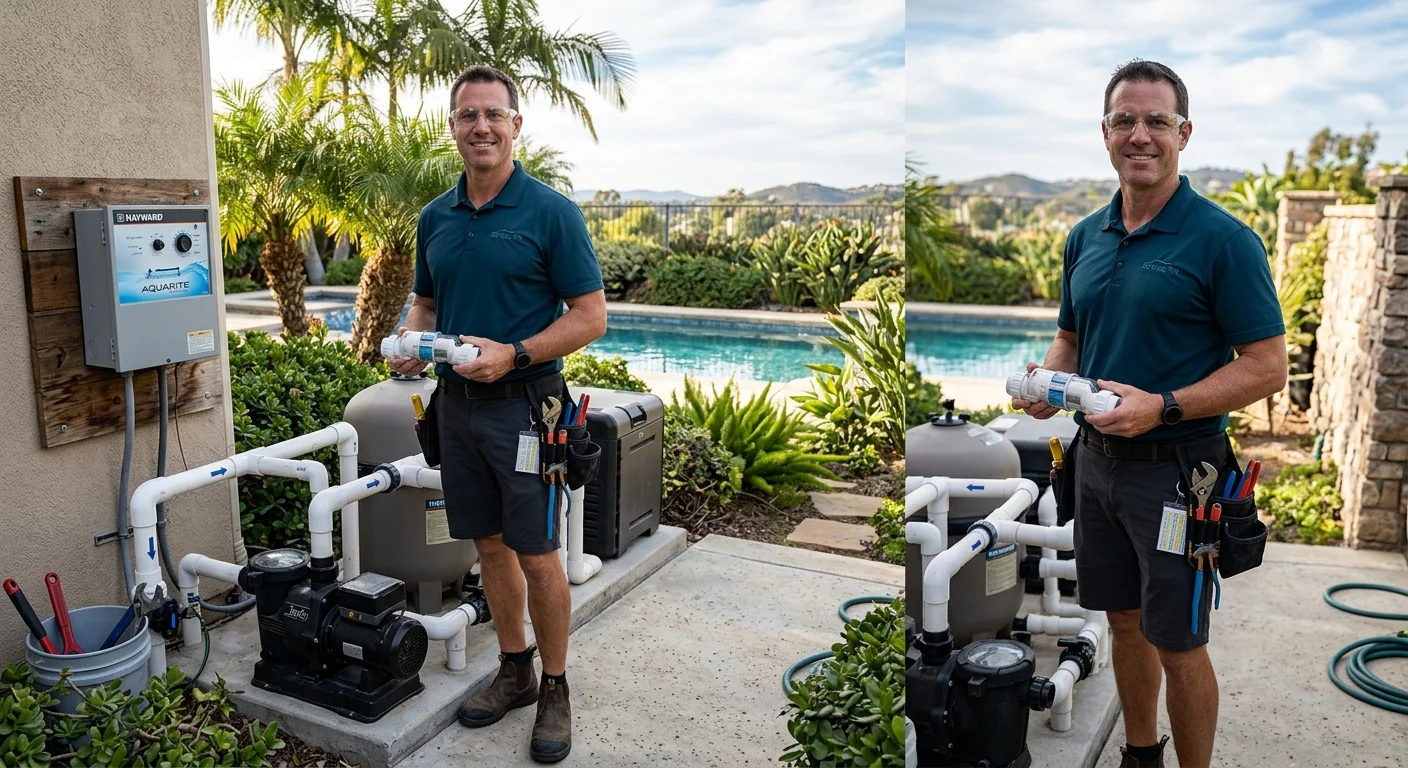
What a working salt cell actually produces
A working salt cell is a small chlorine plant on the equipment pad. The pump pushes salty pool water through stacked metal plates. Current across those plates splits the brine and forms sodium hypochlorite, the same family of sanitizer as liquid chlorine, then sends it back through the returns.
You do not see a jug being poured. You see output. While the generator is on, bubbles form in the cell housing because gas is a byproduct of that reaction. The water leaving the nearest return should test much higher in free chlorine than water from the steps or the deep end. That spike is the proof the cell is working.
The CDC’s healthy swimming guidance calls for at least 1 ppm free chlorine in a home pool, and at least 2 ppm when cyanuric acid or stabilized chlorine is in the water. It also wants pH between 7.0 and 7.8, because chlorine slows down as pH climbs past 7.8 and water gets harder on pipes and equipment below 7.0. A salt system that is truly generating still has to land in that range. A bright generating lamp does not replace a test kit. CDC also prefers a DPD kit over strips, and it wants chlorine and pH checked at least twice a day, more often after a packed weekend.
San Diego sun, sweat, and wind-blown dirt consume chlorine the same way they do in a tablet pool. If the cell is working and the chemistry is balanced, the residual holds between swims. If the residual collapses every afternoon on a west-facing Escondido pad, the next step is still an output test, not another bag of salt. People who just finished a salt water pool conversion often expect the box to babysit the water. It does not. Weekly salt care is still chemistry, runtime, and a cell that can actually make sanitizer. That is the job described in salt water pool maintenance in San Diego, and it is separate from proving the cell itself.
How flow, salinity, and scale fool a reading
The control board does not see chlorine. It sees electrical behavior: flow, conductivity, and the current the plates will take. That is why a salinity error is not the same as a dead cell.
Flow is the first trick. Many units refuse to generate if the flow switch is open. A clogged pump basket, a packed cartridge, a half-closed valve, or air in the line can starve the cell. The board reports low flow or simply stays quiet. The plates may be fine. On a variable-speed pad in Carlsbad or Encinitas, a pump set too low for that cell’s switch will look like a failed chlorinator at 10 a.m. and a healthy one at 2 p.m. when the speed steps up.
Salinity is the second trick. The board estimates salt from how well the water conducts electricity. Temperature, scale on the sensor, and other dissolved minerals all move that number. A handheld kit or a store lab can disagree with the display even when the pool is in a usable range. Adding salt because a light came on is how inland yards end up oversalted, then someone wants to dump water to fix it.
Scale is the third. San Diego fill water is mineral-heavy, especially inland. Calcium prefers hot plates. White crust on the coating acts like insulation. The board then thinks salt is low or the cell is dirty. After a manufacturer-approved clean, output often returns. HomeGuide’s September 2025 pool maintenance guide notes that cells typically need a mild acid wash every 3-4 months unless the unit is self-cleaning. That is a market observation about upkeep, not a homemade recipe and not a schedule from this site. The matched pro follows the cell maker’s cleaning method.
| What you see | What it often means | What a real cell test shows |
|---|---|---|
| Lights say low salt | Scale, cold water, or a dirty sensor changing conductivity | An independent salt test disagrees with the board |
| No generating light | Flow switch open, timer off, or a board that never sent power | No gas in the housing and no chlorine spike at the return |
| White crust on plates | Hard-water scale blocking the coating | After a proper clean, output either returns or stays dead |
| Pool chlorine stays low | Sun, bathers, or a cell that is actually spent | The return sample still matches the rest of the pool |
If the lights are a mess and you have already chased codes, the salt cell not working walkthrough and the San Diego salt-cell troubleshooting companion cover that maze. This page stays on the output test.
The tests a pool pro runs on the cell
A licensed independent pool pro treats the cell like a part under load, not a mystery box.
They start with the pad. Pump running, valves open, cell full of water. They confirm the flow switch is actually closed. A stuck paddle or a scaled sensor will shut generation down with a healthy cell sitting in the housing. Then they look at the board: generating, cell, flow, salt, and any inspect or clean message. A live display with a dead return sample is a different problem than a box with no power at all.
Then they open the cell. Dirty plates look coated and chalky, sometimes brown at the edges, with the gaps between plates filled in. A rinsed cell shows the coating and the open slots again. Warped, flaking, or eaten-away plates are a different story, and that story belongs in the scrap pile, not another rinse.
With the unit generating, they sample at the return. A test tube at the jet, then a DPD reading. Water that just left a working cell can bleach a tablet, so they dilute before they trust a zero. They compare it to a sample from the far side of the pool. No difference means no output. They also watch the housing. Brine moving over live plates should look busy, not like still water in a pipe.
They test salt with an independent kit or a store lab, then compare it to the board. If the water is in range and the board screams otherwise, they look at scale, temperature, and the sensor, not the salt bag. That is how you avoid draining a Santee or El Cajon pool because a crusty cell lied about salinity.
A meter follows the spec sheet
Some manufacturers publish a salt chlorinator cell test that uses a multimeter on the cell leads or the power supply. Those procedures are model-specific. The acceptable readings live in the manual, not in a universal chart. A pro who tests with a meter is checking whether the board is sending power and whether the cell is drawing like a healthy load. Guessing a voltage from memory is how good cells get tossed and dead boards get ignored.
Cell replacement and board work sit on the equipment side of the trade. Ask the pro for a license number and look it up on the CSLB license check before anyone opens the electrical box. Routine skimming is not construction. Repairs and equipment swaps are a different job, and the honest ask is still the license of the person touching the pad.
When a clean cell still belongs in the scrap pile
A cell can look rinsed and still be finished. The catalytic coating wears. Plates thin. Hours add up every time the unit generates, including the extra hours inland yards run through August.
INYO Pools, in its guide on how to know when a salt cell is bad (read August 2026), says an SCG cell can be expected to last 5 or more years if the pool and equipment are maintained properly. That is a retailer estimate. It is not a warranty, and Splash Pro Pools does not promise a lifespan.
The spent-cell picture is consistent. Confirmed flow. Independent salt test in range. Plates cleaned the way the maker allows. Still no gas in the housing. Still no chlorine spike at the return. A board that keeps reporting a spent cell after a reset. Plates that have lost coating, grown holes, or folded toward each other. If the box is dark on every circuit, the cell may be the victim of a board or a supply problem, not the cause.
Angi’s May 2026 saltwater conversion guide puts generator cell replacement in the $700-$1,100 range and a control board in the $500-$900 range. Those are market figures from that guide, not a quote from this referral service. HomeGuide’s September 2025 saltwater package puts salt cells in a $200-$1,400 spread depending on the model. A cheaper cell in a hard-water yard is still a wear part.
Do not keep shocking the pool as a workaround while a dead cell sits on the pad. Liquid chlorine will clear the water and hide the test. When the jugs stop, the residual falls again, and you have learned nothing about the plates.
How San Diego hard water shortens cell life
Hard water and heat crust cells faster than a marine-layer yard in Point Loma or La Jolla. Inland North County and East County, Escondido, Santee, El Cajon, see hotter pads and more evaporation. Evaporation leaves minerals behind. Those minerals settle on salt-cell plates the same way they crust a tile line after a long El Cajon summer.
Pentair’s pool water chemistry education describes white, chalky calcium on tile and equipment as scaling, and ties it to high pH, high alkalinity, and hard water. Santee fill water is very hard. A cell that would rinse clean on a coastal cartridge schedule can scale between visits inland. High pH makes it worse. CDC notes that as pH rises above 7.8, chlorine kills germs more slowly. Scale and a sluggish residual show up together after a hot week with the generator working overtime.
If someone tries to fix salt by dumping water, the City of San Diego bans saline pool water in storm drains and gutters unless a very specific path to a naturally saline body exists. Other cities in the county run their own stormwater programs, so check local rules before anyone opens a valve. The San Diego County Water Authority lists the retail agencies that actually set rates and, in practice, the refill chemistry you live with. Fallbrook and Bonsall sit outside that member list, which is another reason a county-wide salt target copied from a forum does not travel.
The waterline tells the same mineral story. If the tile is already armored with scale, the cell has been swimming in that water too. Hard-water pool care and tile and calcium cleaning are the surface side of the same inland chemistry. Cleaning the plates without balancing pH just puts the crust back on a shorter clock.
When to call us
When the return sample is flat, the plates are scaled or worn, or the board and a lab salt test disagree, stop guessing at the salt bag. A licensed pool service pro should run the output test, inspect the cell, and decide whether cleaning, a board, or a replacement cell is the real fix. Call us at (760) 642-1256 and we’ll connect you with a licensed local pool pro.
Frequently asked questions
How can I tell if my salt cell is bad?
After confirmed flow, an independent salt test, and a proper clean, a bad cell still produces no chlorine spike at the return and little or no gas in the housing. Worn, flaking, or eaten plates are a visual tell. Lights on the box are not proof by themselves.
How do you test a salt chlorinator cell with a multimeter?
A meter test follows the manufacturer's procedure for that model. The pro checks whether the power supply is sending current and whether the cell draws like a healthy load. There is no universal voltage that fits every brand, so the spec sheet controls the reading.
How do I know if my chlorinator is broken?
Separate the board from the cell. A dark box with no power is a supply or control problem. A live box, good flow, salt in range, and no chlorine at the return points at the cell. Error lights often mean scale, temperature, or a flow switch, not a failed generator.
What does a dirty salt cell look like?
Dirty plates show white, chalky crust, sometimes with brown staining at the edges, and the gaps between plates fill in. After a manufacturer-approved rinse, the coating should be visible again. If the crust is gone and output is still zero, the cell is worn, not dirty.
Why does a low-salt light not prove the cell is dead?
The board estimates salt from how well the water conducts electricity. Scale, cold water, and extra dissolved minerals all change that reading. An independent salt test is the check. If the water is actually in range, the pro looks at the cell and the sensor instead of adding salt.
Need professional help in San Diego County?
Splash Pro Pools connects San Diego homeowners with pool pros for the work in this post.