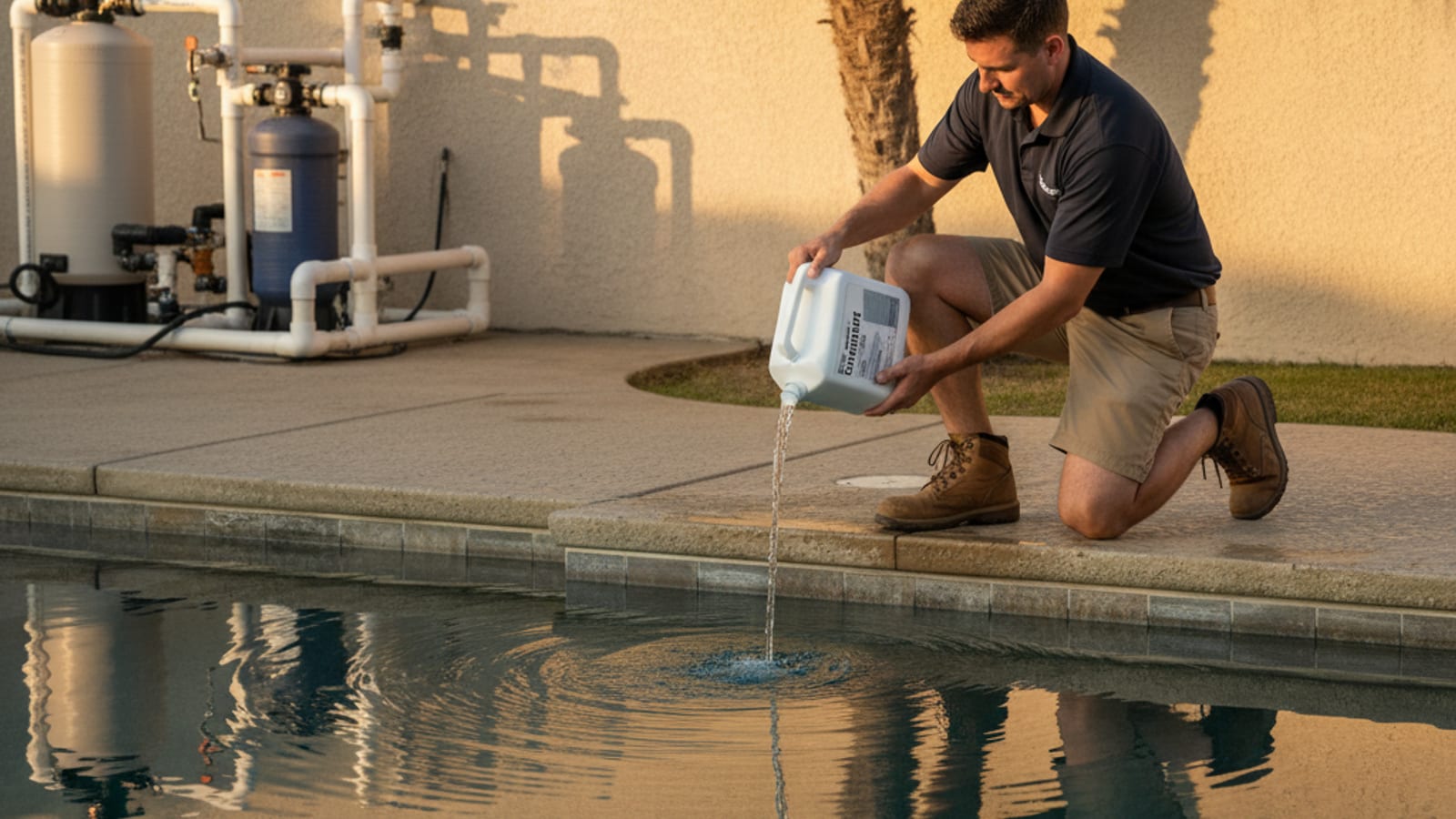
Shocking a pool isn’t complicated, but most DIY attempts fail because people skip the one step that matters most: measuring cyanuric acid first. Your pool’s CYA level determines how much shock you actually need. Without that, you’re just guessing — which is why the bag says “one bag per 10,000 gallons” but the algae keeps coming back anyway. This guide covers exactly when to shock, how much to use based on your CYA, which products to buy, and the six mistakes that cause most shock treatments to fail.
When to shock your pool
Shocking isn’t just an algae-response tool. Regular shocking keeps chlorine sanitizer working correctly. Here’s when to shock:
Weekly or every other week during peak season. Sunlight, bather load, sweat, sunscreen, and organic debris all consume chlorine. Shocking clears the accumulated junk and resets your sanitizer. In San Diego’s year-round swim climate, weekly shocking through summer is the standard.
After a pool party or heavy use. More bodies equal more contamination. Shock the night after any heavy-use day.
After heavy rain or Santa Ana winds. Rain dilutes chemistry; wind drops dust, ash, and debris. Both spike chlorine demand.
At the first sign of algae. Light green tint, cloudy water, or algae starting on walls — shock before it spreads.
After refilling or a big top-up. New water has chloramines and needs sanitation jumpstart.
After stabilizer (CYA) adjustments. If you’ve raised or lowered CYA, shock to reset chlorine levels to the new target.
The CYA-shock math that actually matters
Here’s what the pool store doesn’t tell you: chlorine’s killing power depends on the ratio of free chlorine to cyanuric acid. Stabilizer (CYA) protects chlorine from UV but also chemically binds it — reducing the amount available to actually kill algae and bacteria.
The rule of thumb: effective shock = CYA × 0.4 for free chlorine target.
- CYA 30 ppm → need 12 ppm free chlorine to shock
- CYA 50 ppm → need 20 ppm free chlorine
- CYA 70 ppm → need 28 ppm free chlorine
- CYA 90 ppm → need 36 ppm free chlorine (too high — drain water)
- CYA 100+ ppm → shock won’t work. Drain and dilute first.
Your water volume determines how much chlorine gets you there. For a 20,000-gallon pool:
- Raising free chlorine by 10 ppm = about 2 gallons of 8.25% household bleach
- Raising by 20 ppm = about 4 gallons
- Raising by 30 ppm = about 6 gallons
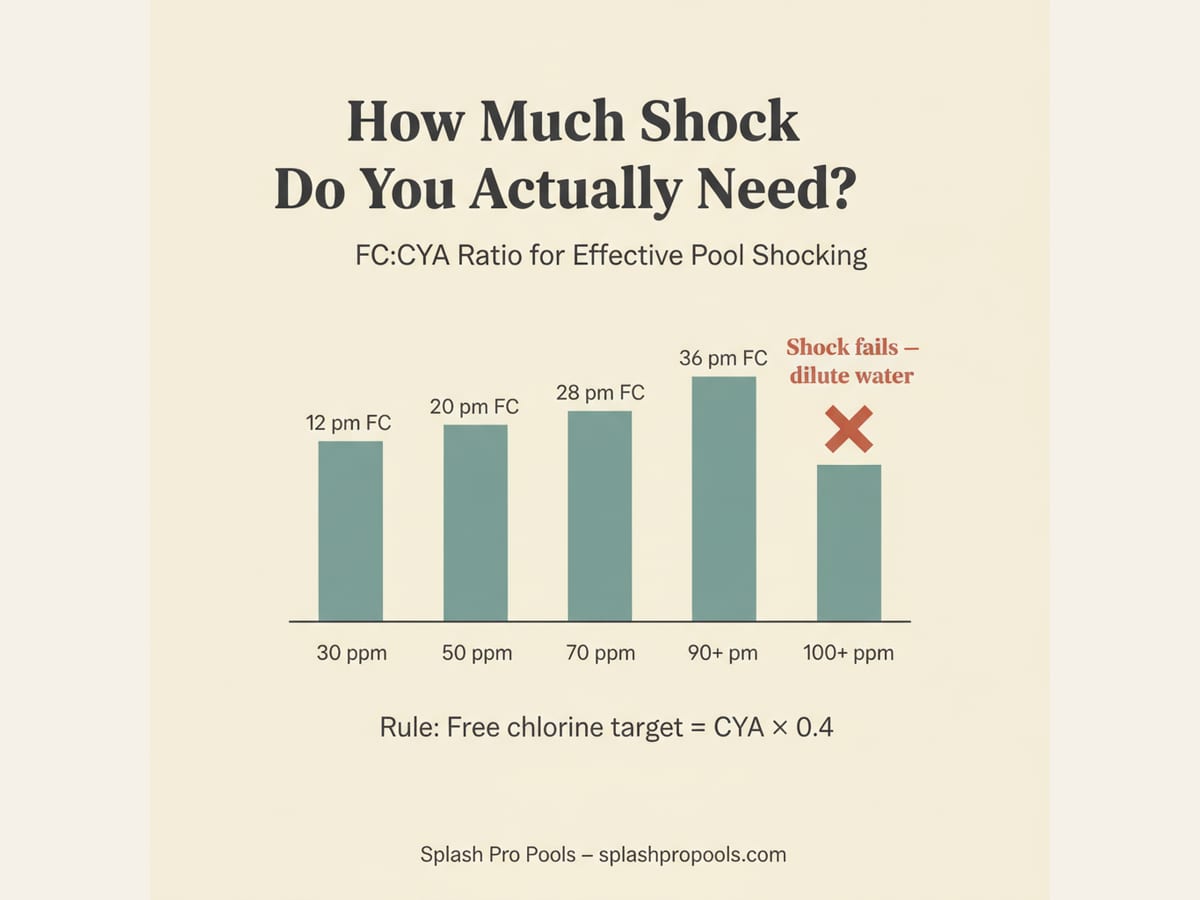 The FC:CYA ratio chart for effective pool shocking. If CYA is above 80 ppm, chemical shock alone often won’t finish the job.
How to shock a pool step by step
Tools needed: pool test kit (one that measures CYA), liquid chlorine (8.25% household bleach works great), muriatic acid if pH is high.
Step 1: Test the water. Measure CYA, pH, free chlorine, and total alkalinity. This is non-negotiable. Shocking without testing CYA is why most treatments fail.
Step 2: Check CYA level.
- Under 60 ppm: proceed to shocking
- 60 to 80 ppm: shock aggressively
- Over 80 ppm: drain and dilute water before shocking
Step 3: Adjust pH if needed. Chlorine is most effective at pH 7.2 to 7.4. If your pH is above 7.6, add muriatic acid and wait 30 minutes with the pump running before shocking.
Step 4: Calculate chlorine needed. Use your CYA level × 0.4 as the free chlorine target. Subtract your current free chlorine to find how much you need to raise it. For a 20,000-gallon pool, roughly 1 gallon of 8.25% bleach raises free chlorine 5 ppm.
Step 5: Add chlorine in the evening. Sunlight destroys chlorine fast. Shocking at sunset gives the chemistry time to work overnight without UV degradation.
Step 6: Run the pump. Continuous circulation for 8 to 24 hours depending on severity. No circulation = no killing power.
Step 7: Brush the pool. For algae treatments, brush walls and floor within an hour of shocking. This breaks up algae biofilm so chlorine can reach the cells.
Step 8: Test again in the morning. If chlorine dropped back to normal overnight, the shock worked. If it’s still elevated, keep running the pump. If algae is still visible, shock again.
Step 9: Wait to swim. Don’t swim until free chlorine drops to 5 ppm or below.
Which shock product to buy
Best default: liquid chlorine (sodium hypochlorite). Buy 8.25% household bleach (Clorox, store brand) at any grocery store. Cheapest, no additives, works. For heavier doses, buy pool-store liquid chlorine at 10% or 12.5% concentration.
For extremely low CYA pools: dichlor shock. Adds both chlorine and stabilizer. Useful if your CYA is under 20 and needs raising anyway. Don’t use on pools with CYA over 30 — you’ll quickly end up over-stabilized.
For pools with low calcium hardness (rare in San Diego): cal-hypo shock. Adds calcium alongside chlorine. San Diego’s hard water usually doesn’t need more calcium, so skip this unless you’ve drained recently.
Avoid: trichlor shock tablets. Drops pH aggressively, adds lots of CYA. Not a good choice for weekly shocking.
Six reasons shock treatments fail
- CYA too high. Most common cause. Drain and dilute.
- pH too high. Shock at pH below 7.5.
- Not enough chlorine. One bag isn’t enough for most pools over 15,000 gallons.
- No brushing. Algae biofilm blocks chlorine from reaching cells.
- Not circulating long enough. Run the pump continuously for 24-48 hours on algae treatments.
- Phosphates. Feed algae faster than chlorine can kill it. Test and treat separately.
Salt pool shocking
Salt pools produce low-level chlorine continuously, but they can’t usually produce enough to shock. Most modern salt systems have a “super chlorinate” or “boost” mode that runs the cell at maximum for 24 hours. That usually gets free chlorine high enough for light maintenance shocking.
For serious shocking (algae or heavy contamination), add liquid chlorine on top of the salt system’s boost mode. The salt cell can’t keep up with the chlorine demand of a green pool.
San Diego-specific shocking notes
Hard water considerations. In hard-water cities like El Cajon and San Marcos, avoid cal-hypo shock — your calcium hardness is already high and more calcium accelerates scale on tile and equipment.
Peak season timing. San Diego summer temperatures hit pool water hard. Shock weekly through July and August, every other week in cooler months.
Post-fire shocking. After Santa Ana winds or wildfire smoke events, shock immediately. Ash contains organic material that consumes chlorine aggressively.
If you’re dealing with a pool that won’t clear after shocking, or you’re not sure what your CYA is, call (858) 400-8901 or see our green pool recovery service page for same-week fixes across San Diego County.
Frequently asked questions
How much shock do I need to add to my pool?
Shock dose depends on your cyanuric acid (CYA) level, not just pool volume. At 30 ppm CYA, you need free chlorine at 12 ppm to effectively shock. At 60 ppm CYA, you need 24 ppm. At 80 ppm, you need 32 ppm. The 'FC:CYA ratio' should stay at roughly 40% of your CYA level for effective shocking. Measure CYA first.
How long does pool shock take to work?
For routine shocking (non-algae), 4 to 8 hours of circulation is enough — the chlorine oxidizes contaminants and then normal sanitizer levels return. For algae treatment, shock needs to maintain high free chlorine for 24 to 48 hours while you brush and filter. Most bodies should wait until free chlorine drops to 5 ppm or below before swimming.
Is liquid chlorine better than shock bags?
For most San Diego pools, liquid chlorine (sodium hypochlorite) is better than powdered cal-hypo or dichlor shock bags. Liquid contains no stabilizer or calcium to build up over time. Cal-hypo adds calcium hardness. Dichlor adds CYA, which is usually already too high in established pools. Pool store shock bags cost 3 to 5 times more per effective dose than grocery-store 8.25% bleach.
Why did my pool shock not work?
The most common reason pool shock fails is high cyanuric acid (CYA) making the chlorine ineffective. A pool with 90 ppm CYA needs shock at 36 ppm free chlorine — far more than one shock bag provides. Other causes: pH too high (above 8.0), didn't brush algae to break biofilm, filter clogged and not circulating, or phosphates feeding algae faster than chlorine kills it.
Need professional help in San Diego County?
Splash Pro Pools provides every service in this post. Call for a free quote.