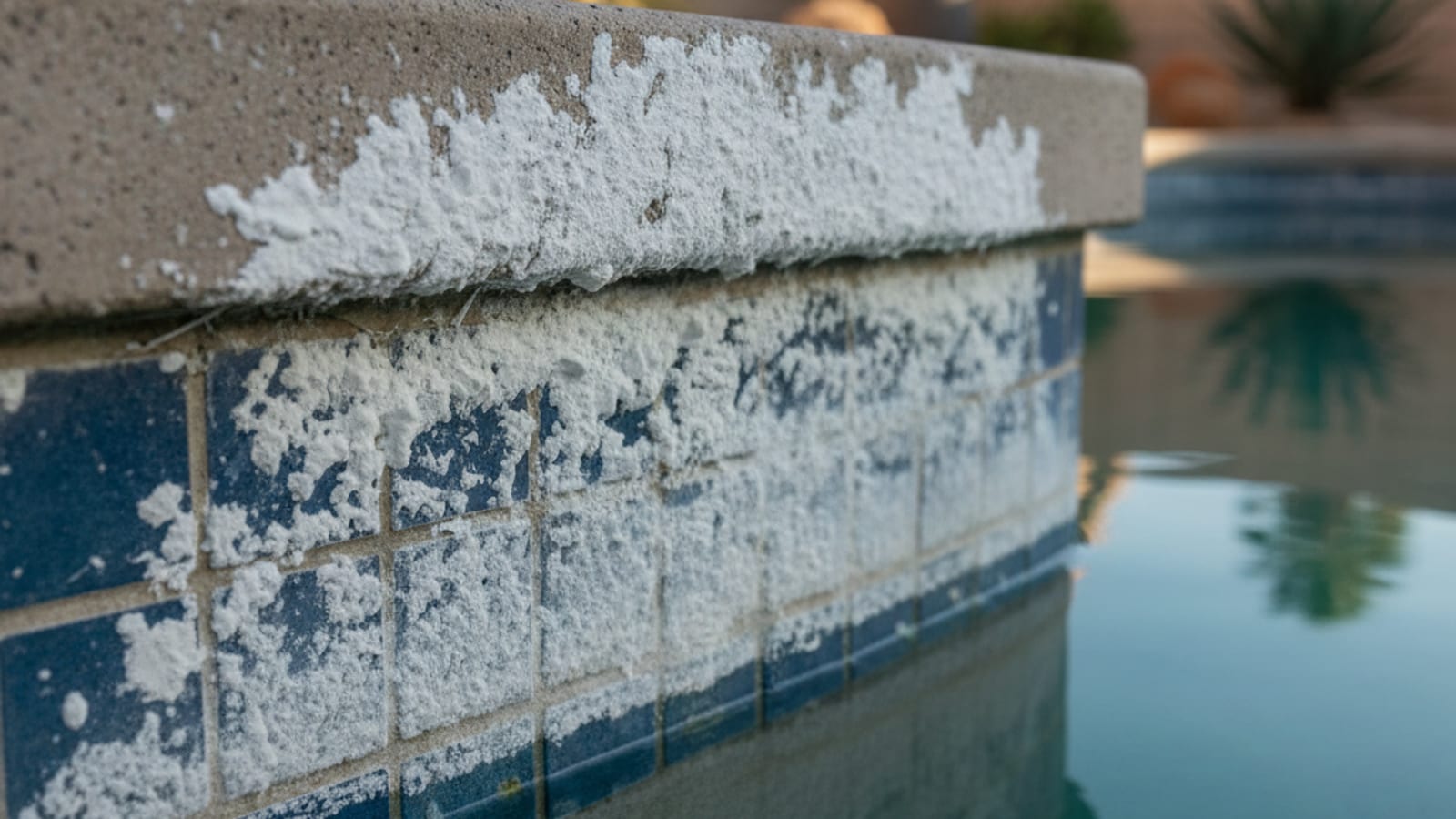
San Diego County has some of the hardest municipal water in California — and your pool shows it. That white chalky line on your waterline tile? Calcium. The crust in your salt cell? Calcium. The declining heater efficiency? Scale on the heat exchanger. Calcium. After a decade of servicing pools from Encinitas to El Cajon, we can tell you exactly what San Diego’s hard water does to pools and what actually works to manage it. This guide is built for homeowners who want to understand the problem and fix it right the first time.
How hard is San Diego water?
Water hardness is measured in grains per gallon (gpg) or parts per million (ppm). 1 gpg = 17.1 ppm. For context:
- Under 3.5 gpg: soft
- 3.5 to 7 gpg: moderately hard
- 7 to 10.5 gpg: hard
- 10.5 to 14 gpg: very hard
- Over 14 gpg: extremely hard
San Diego County runs 10 to 20+ gpg depending on where you live.
By water district
- Helix Water District (El Cajon, La Mesa, Lemon Grove, Granite Hills, Casa de Oro): 16 to 20 gpg — extremely hard
- Otay Water District (Rancho San Diego, Spring Valley, parts of Chula Vista): 14 to 16 gpg — very hard
- Padre Dam Municipal Water District (Santee): 14 to 16 gpg — very hard
- Vallecitos Water District (San Marcos): 14 to 18 gpg — very hard
- Rainbow Municipal Water District (Bonsall, Rainbow): 14 to 18 gpg — very hard (100% Colorado River)
- Escondido Utilities: 12 to 16 gpg — hard
- Vista Irrigation District: 12 to 14 gpg — hard
- City of Oceanside: 12 to 14 gpg — hard
- Carlsbad Municipal Water District: 10 to 12 gpg — moderately hard
- Olivenhain Municipal Water District (Encinitas): 10 to 14 gpg — hard
- Santa Fe Irrigation District (Rancho Santa Fe, Solana Beach): 10 to 12 gpg — moderately hard
- City of San Diego (La Jolla, Pacific Beach, Rancho Bernardo): 10 to 12 gpg — moderately hard
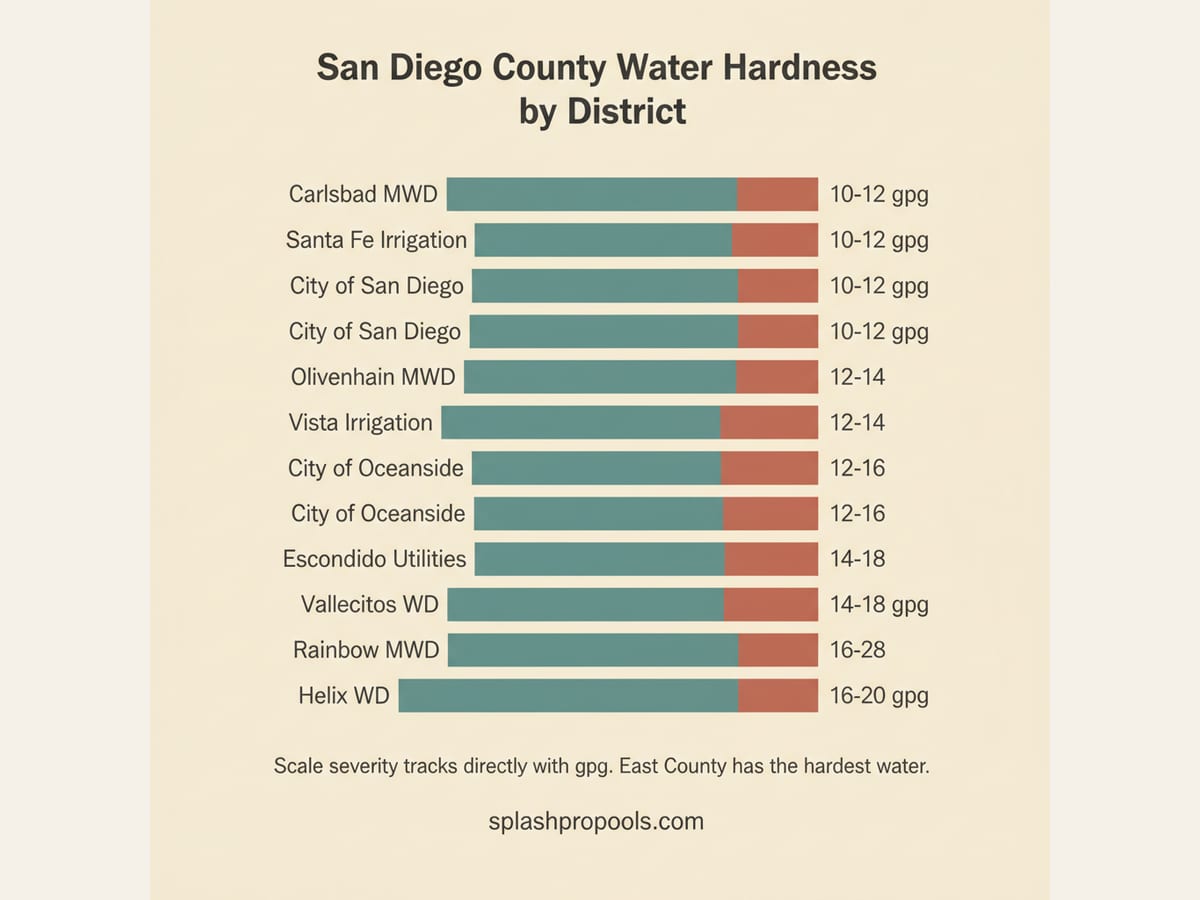 San Diego County water hardness by district. The Colorado River sources inland and East County deliver the hardest water; coastal blends are softer.
What hard water actually does to your pool
Calcium scale on tile
The most visible problem. As water evaporates from the pool surface, minerals concentrate at the waterline. Over time, a white chalky line forms on the tile — calcium carbonate scale. In East County pools, visible scale can form within a few months. In coastal pools, it takes a year or two.
Scale doesn’t come off with normal scrubbing. DIY pumice stones work on light scale but scratch glass tile. Professional bead blasting with food-grade aggregate removes heavy scale without damage. In San Marcos, El Cajon, and Rancho San Diego, tile cleaning is one of our most-requested services.
Scale on salt chlorine generators
Salt cells produce chlorine by electrolysis. The cell has metal plates that water flows across. Calcium deposits on those plates, reducing the plate surface area and killing chlorine output. On a hard-water San Diego pool, salt cells need cleaning every 3 months to maintain output. Neglected cells die in 2 to 3 years instead of 5 to 7.
Scale in pool heaters
Calcium deposits on the heat exchanger tubes inside a gas heater. This:
- Reduces thermal efficiency — your heater costs more to run
- Creates hot spots that eventually crack the heat exchanger
- Triggers pressure-switch faults as flow restricts
Heater replacement is expensive ($2,500 to $4,500 installed). Annual flushing with a scale-removing solution can extend heater life from 6 to 8 years up to 12+ years in hard water areas.
Scale on cartridge filters
Calcium embeds in cartridge pleats. Normal rinsing doesn’t remove it. Filter pressure rises faster than normal after cleaning. Cartridges that should last 3 to 5 years only make 2 to 3 in hard water.
Clogged plumbing
Over decades, calcium deposits inside PVC plumbing reduce flow. Rare but real in pools that are 30+ years old and never had chemistry management.
What to do about hard water
You can’t change your water source, but you can manage the effects.
1. Maintain aggressive chemistry
- Keep pH at 7.4 (not higher). Higher pH accelerates scale formation.
- Keep total alkalinity at 80 to 100 ppm (lower end of range for hard water pools).
- Use the Langelier Saturation Index (LSI) if you want to get technical — target 0 to +0.3 for balanced water.
- Test calcium hardness monthly. If over 500 ppm, plan a partial water change.
2. Use a scale inhibitor
Products like SeaKlear Metal Klear, Natural Chemistry Scale Free, or BioGuard Stain & Scale Control slow calcium from coming out of solution. Add monthly or quarterly depending on product. In East County, scale inhibitors are essentially mandatory for keeping tile clean.
3. Clean salt cells quarterly
Remove the cell, inspect the plates. If you see white scale, soak in a 1:10 muriatic acid to water solution for 15 minutes, rinse thoroughly, reinstall. This alone extends cell life dramatically.
4. Annual heater flush
Especially for natural gas heaters. A descaling solution circulated through the heat exchanger removes calcium before it causes damage. Most homeowners skip this step and regret it when the heater fails at year 6 instead of year 12.
5. Professional tile cleaning
Every 2 to 5 years in most San Diego pools, more often in hard-water districts. Bead blasting removes accumulated scale. Without it, scale builds faster and faster — eventually reaching a point where it won’t fully come off.
6. Partial water changes
When calcium hardness exceeds 600 ppm in your pool, partial drain and refill is the only practical fix. Drain 25 to 50% of water, refill with fresh water. The new water dilutes the concentrated calcium. In San Diego, this is usually needed every 3 to 5 years on hard-water pools.
7. Pre-filter fill attachments
Pelican, Aquasana, and similar whole-house pre-filters reduce hardness in incoming water. Adds cost ($500 to $1,500) but pays off in reduced scale formation, extended equipment life, and fewer tile cleanings.
Should you convert to salt water in hard-water areas?
A common question. Salt water pools add complexity in hard water:
- Salt cells scale up faster (address with more frequent cleaning)
- Higher pH creep (address with more muriatic acid)
- Some equipment isn’t salt-rated (inspect before converting)
But salt water pools also solve problems:
- Softer-feeling water
- Lower chemical cost
- More consistent sanitation
In East County and inland areas, salt water conversion works fine with attentive maintenance. In coastal areas with moderate hardness, it’s straightforward. The decision usually comes down to whether you want the softer water feel enough to accept the added salt cell maintenance. See our salt water conversion service page for install details.
The homeowner’s hard-water playbook
Practical summary for any San Diego pool owner:
- Test calcium hardness monthly. Don’t skip this.
- Keep pH at 7.4. Higher pH = more scale.
- Brush tile weekly. Prevents scale from getting a foothold.
- Clean salt cell every 3 months. Non-negotiable in hard water.
- Add scale inhibitor quarterly. Slows calcium precipitation.
- Schedule professional tile cleaning every 2 to 5 years. Before scale is too thick to remove.
- Plan for partial drain every 3 to 5 years. Hardness concentrates over time.
If your pool is already showing heavy scale or you’ve never had professional tile cleaning, start there. Bead blasting transforms a pool’s appearance in one visit. Call (858) 400-8901 or see our pool tile cleaning service page for more.
Frequently asked questions
How hard is San Diego water?
San Diego County water hardness ranges from 10 to 20+ grains per gallon (gpg) depending on which water district supplies your home. East County pools served by Helix Water District run 16 to 20 gpg — among the hardest municipal water in California. Coastal pools served by Olivenhain or Carlsbad Municipal Water District run 10 to 12 gpg. North County inland (San Marcos, Bonsall, Rainbow) runs 14 to 18 gpg on Colorado River-sourced supplies.
What does hard water do to a pool?
Hard water scales up pool tile, plaster, and equipment with white calcium deposits that get progressively worse over time. Scale inside pool heaters reduces efficiency and eventually cracks heat exchangers. Scale on salt cells reduces chlorine output. Scale on cartridge filter pleats restricts flow and requires more frequent cleaning. Visible tile scale is the most common complaint but the hidden equipment damage costs more to fix.
How do I remove calcium scale from pool tile?
Professional bead blasting with food-grade aggregate is the most effective method — it removes heavy scale from glass mosaic, porcelain, and ceramic tile without damaging the surface. Acid washing works for lighter buildup. DIY pumice stones can remove light scale but cause permanent scratches on glass tile. In San Diego's hard-water areas, tile cleaning every 2 to 5 years is typical.
Can I soften my pool water?
There are pre-filter attachments that reduce hardness in fill water, and there are reverse-osmosis pool water treatment services that remove calcium from existing pool water (without draining). Neither is a permanent fix — hardness keeps entering with every top-off. The practical approach is accepting San Diego's hard water and managing it through regular cleaning, scale inhibitor treatments, and salt cell / filter maintenance.
Need professional help in San Diego County?
Splash Pro Pools provides every service in this post. Call for a free quote.