The kit price is usually cheaper than a builder quote. Excavation, plumbing, electrical, decking, and permits are usually not in that price, and they often cost more than the kit. San Diego cities still want a permit and a legal barrier. Very few of these jobs are fully DIY from dirt to swim.
What a DIY pool kit actually includes
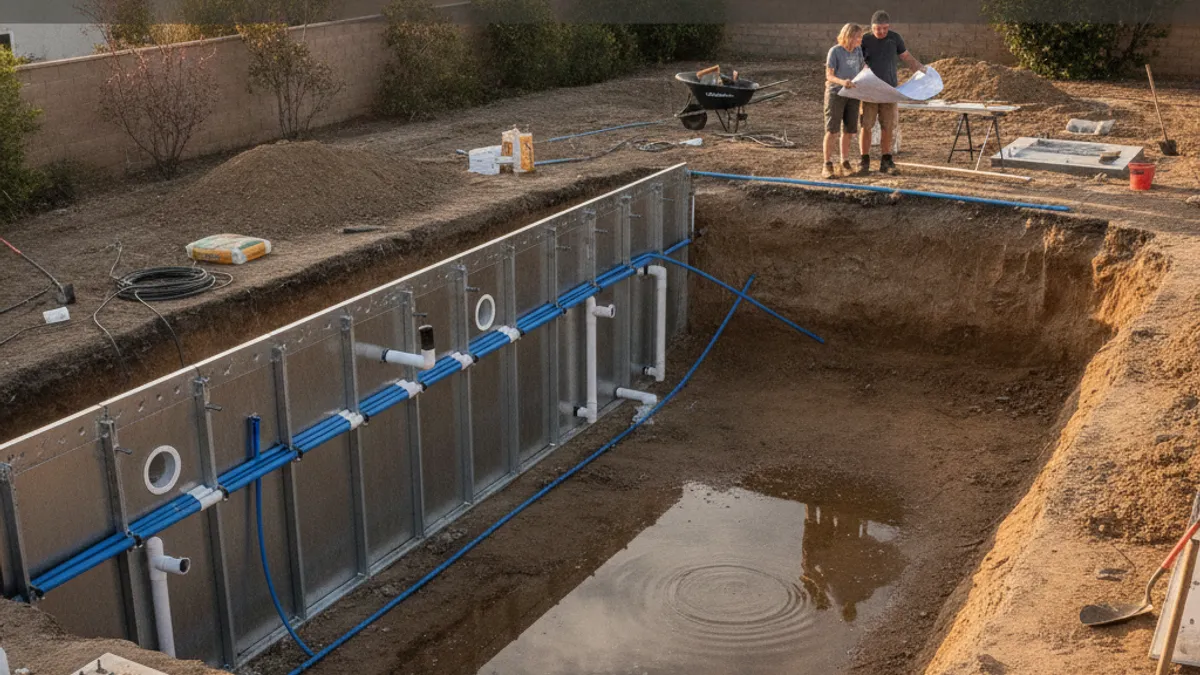
Most kits ship the structural components: steel, aluminum, or polymer wall panels that form the pool’s shape, a vinyl liner cut to fit, and often a basic equipment package, a pump and filter sized for the pool’s volume. That’s a real and substantial part of a pool project, but it’s also the part that’s easiest to manufacture and ship as a standardized product. Everything site-specific, the hole in the ground, the plumbing connections, the electrical work, and the finished decking around the pool, is left for the buyer to arrange separately.
The costs that show up after the kit arrives
Excavation. Very few DIY builders dig the hole by hand. Hiring an excavator and operator to dig and shape the pool cavity to the kit’s exact specifications is typically the first major cost beyond the kit price itself, and San Diego’s varied soil, clay in some areas, rock and decomposed granite in others, can make this more expensive and time-consuming than it would be on flatter, more uniform ground.
Plumbing and electrical. Running the plumbing lines between the pool and the equipment pad, and wiring the pump circuit correctly, including the bonding required for pool safety, is specialized work. Most jurisdictions require licensed trades for the electrical portion specifically to pass inspection, even on an otherwise DIY project.
Decking and coping. A pool kit gives you a water-holding shell. It doesn’t give you a deck to walk around it, sit beside it, or meet basic safety clearances. Concrete, pavers, or another decking material, plus the coping that caps the pool’s edge, is a separate project with its own real cost.
Permits and inspections. Most San Diego County jurisdictions require permits for new pool construction, covering structural work, electrical bonding, and pool barrier or fencing compliance. Requirements vary by city, so check with your local building department directly rather than assuming a kit project is exempt because it’s owner-built. We cover the barrier and fencing side specifically in our California pool fence law guide, since that requirement applies regardless of who built the pool.
Warranty conditions. Kit manufacturers generally specify an installation process for their warranty to hold. Skipping steps or improvising to save time can void coverage on the wall panels or liner if something goes wrong later, so it’s worth reading those terms closely before deviating from the instructions.
Why the total often surprises people
Add excavation, plumbing, electrical, decking, and permit fees to the kit price, and many buyers find the gap between a DIY project and hiring a licensed pool contractor for a complete build is smaller than the kit’s sticker price suggested on its own. That doesn’t mean a DIY kit is never worth it. For an owner with real construction experience, the time to manage multiple subcontractors, and a realistic budget for everything beyond the kit itself, it can still save real money. The mistake is budgeting only for the kit and getting surprised by everything else along the way.
What we’d tell a friend considering this
Get a full quote from a licensed pool contractor first, even if you’re leaning toward the DIY route, so you know what the real gap actually is for your specific yard and soil conditions. Then price out excavation, electrical, and decking separately before deciding. A realistic side-by-side comparison, not just the kit price against a contractor’s full quote, is the only way to know if DIY genuinely saves you money on your particular project.
Frequently asked questions
Are DIY inground pool kits actually cheaper than hiring a pool builder?
The kit itself is usually cheaper than a fully built pool from a contractor, but the kit price rarely includes excavation, plumbing, electrical, decking, or permit fees. Once those are added, the total cost gap between a DIY kit project and a professionally built pool often narrows significantly.
Do I need a permit to install a DIY pool kit in San Diego County?
In most San Diego County jurisdictions, yes. New pool construction typically requires permits and inspections covering structural, electrical bonding, and pool barrier or fencing compliance, regardless of whether the shell is a kit or professionally built. Check with your specific city’s building department before starting, since requirements vary by jurisdiction.
Can I really excavate and install a pool kit myself without a contractor?
Some determined owners do the wall panel assembly and liner installation themselves, but excavation almost always requires hired heavy equipment and an operator, and plumbing and electrical connections typically need licensed trades to pass inspection. Very few DIY pool projects are entirely self-performed from start to finish.
Does a DIY pool installation affect the manufacturer’s warranty?
It can. Many pool kit manufacturers require installation per their specific instructions for the warranty to remain valid, and improvised steps to save time or money can void coverage on the wall panels or liner. Read the warranty terms before deviating from the manufacturer’s installation guide.
Once your pool, kit-built or contractor-built, is in the ground and filled, keeping the water balanced and the equipment running is where we come in. Call us at (760) 642-1256 to set up service once your new pool is ready for regular care.
Frequently asked questions
Are DIY inground pool kits actually cheaper than hiring a pool builder?
The kit itself is usually cheaper than a fully built pool from a contractor, but the kit price rarely includes excavation, plumbing, electrical, decking, or permit fees. Once those are added, the total cost gap between a DIY kit project and a professionally built pool often narrows significantly.
Do I need a permit to install a DIY pool kit in San Diego County?
In most San Diego County jurisdictions, yes. New pool construction typically requires permits and inspections covering structural, electrical bonding, and pool barrier or fencing compliance, regardless of whether the shell is a kit or professionally built. Check with your specific city's building department before starting, since requirements vary by jurisdiction.
Can I really excavate and install a pool kit myself without a contractor?
Some determined owners do the wall panel assembly and liner installation themselves, but excavation almost always requires hired heavy equipment and an operator, and plumbing and electrical connections typically need licensed trades to pass inspection. Very few DIY pool projects are entirely self-performed from start to finish.
Does a DIY pool installation affect the manufacturer's warranty?
It can. Many pool kit manufacturers require installation per their specific instructions for the warranty to remain valid, and improvised steps to save time or money can void coverage on the wall panels or liner. Read the warranty terms before deviating from the manufacturer's installation guide.
Need professional help in San Diego County?
Splash Pro Pools connects San Diego homeowners with pool pros for the work in this post.