Cloudy pool water almost always comes down to one of seven causes, and once you know which one, the fix is straightforward. The problem is that most homeowners treat all cloudy pools the same way — dump in a bag of clarifier, hope for the best — and the cloudiness comes right back because the root cause is still there. This guide walks through the seven causes in order of how common they are in San Diego pools, how to diagnose each one, and the fix.
Test before treating
Before doing anything, test the water. Key readings that matter for cloudiness:
- pH (target 7.4 to 7.6)
- Total alkalinity (target 80 to 120 ppm)
- Free chlorine (target 1 to 3 ppm for chlorine pools, 1 to 2 ppm for salt)
- Calcium hardness (target 200 to 400 ppm; San Diego often runs 400+)
- Cyanuric acid / stabilizer (target 30 to 50 chlorine, 60 to 80 salt)
- Phosphates (ideally under 100 ppb)
Write down the values. Most cloudy pools will have at least one reading out of range, and that’s your starting point.
Cause 1: pH too high
How to identify: pH above 7.8 in combination with San Diego’s typically high calcium hardness. Water may have a faint white haze that looks almost milky.
Why it happens: San Diego municipal water runs alkaline. Salt pools drift high from the chlorination process. If you haven’t added acid in a few weeks, pH can climb quickly, especially in hot weather.
The fix: Add muriatic acid to bring pH to 7.4. For a 20,000-gallon pool, about 1 cup lowers pH roughly 0.2 points. Circulate for 4 hours, retest, adjust. Cloudiness usually clears within 24 to 48 hours once pH is back in range.
Cause 2: Total alkalinity too high
How to identify: Alkalinity over 140 ppm, often paired with high pH. Water is hazy, pH drifts upward frequently despite acid additions.
Why it happens: Over-adding sodium bicarbonate, using trichlor tablets (which don’t affect alkalinity but let it drift), or starting with high-alkalinity fill water.
The fix: Lower alkalinity with muriatic acid — slowly. Add acid, run pump without aeration (keep fountains and waterfalls off) for 24 hours. Aeration raises pH but not alkalinity, so this trick lets alkalinity drop while pH rebounds. Repeat daily until alkalinity is 80 to 120 ppm.
Cause 3: Low chlorine (early algae)
How to identify: Free chlorine below 1 ppm, especially after a hot weekend. Water has a faint green tint or smells “pool-like” (chloramines).
Why it happens: Sanitizer ran out due to heavy use, UV, or high bather load. Algae started blooming before it’s visibly green.
The fix: Shock the pool based on your CYA level. Brush walls and floor. Run filter 24/7 for 48 hours. See our full green pool recovery guide if it’s already green.
Cause 4: Clogged or exhausted filter
How to identify: Filter pressure is 10+ PSI above clean baseline. Water has been cloudy for more than a few days without chemistry changes.
Why it happens: Filter is due for cleaning, cartridge is exhausted, or sand is past its 5-to-7-year lifespan.
The fix: Clean the filter. If cloudiness persists after cleaning and pressure still rises fast, replace the media. See our pool filter cleaning guide for step-by-step instructions for cartridge, DE, and sand filters.
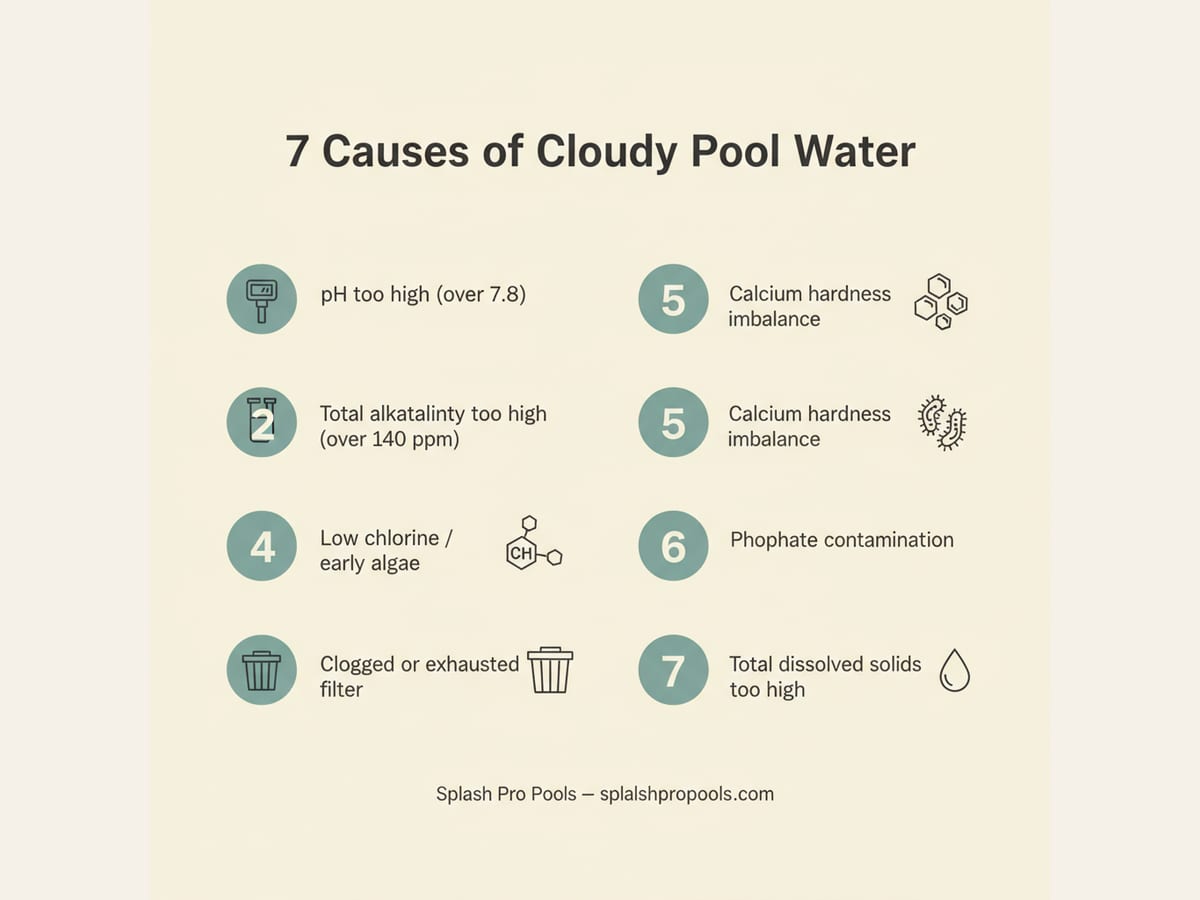 The seven most common causes of cloudy pool water, ordered by how often we see each one on service calls in San Diego.
Cause 5: Calcium hardness imbalance
How to identify: Calcium hardness over 500 ppm, especially in East County El Cajon, La Mesa, or Rancho San Diego. Water has white haze, scale visible at waterline.
Why it happens: San Diego’s very hard water (16 to 20 gpg in East County) concentrates through evaporation. Over months, calcium comes out of solution as temperature rises or pH climbs.
The fix: Partial drain and refill. Drain 25 to 50% of water, refill with fresh water. In San Diego, consider a pre-filter hose attachment to reduce incoming calcium. Add scale inhibitor to slow future buildup.
Cause 6: Phosphate contamination
How to identify: Persistent cloudiness despite balanced chemistry. Algae keeps coming back within a week of every shock treatment.
Why it happens: Fertilizer runoff, leaves and organic debris, some pool chemicals, municipal water sources. Phosphates feed algae.
The fix: Test phosphates. If over 300 ppb, use a phosphate remover (SeaKlear, No More Phosphates). Most phosphate removers turn the pool cloudy temporarily as they bind phosphates into filterable particles. Run the filter continuously for 24 hours after application, clean the filter after.
Cause 7: Total dissolved solids (TDS) too high
How to identify: Pool has gone years without draining. Water feels different, tastes salty, or just won’t clear despite everything being in range.
Why it happens: Salts, minerals, and byproducts accumulate over time. Pool additions of chlorine, acid, stabilizer, etc. all leave behind dissolved solids.
The fix: Partial drain and refill. Drain 30 to 50% of water. This is often required every 3 to 5 years in San Diego, more often in hot inland areas with aggressive evaporation.
The order to diagnose
If your pool is cloudy and you’re not sure what’s causing it, run through this checklist in order:
- Test pH and alkalinity. Adjust if out of range.
- Test free chlorine. Shock if low.
- Check filter pressure. Clean if high.
- Run filter 24/7 for 48 hours.
- If still cloudy, test calcium hardness. Partial drain if over 500 ppm.
- Test phosphates. Treat with remover if over 300 ppb.
- If still cloudy after all above, consider a partial drain for TDS.
Common treatment mistakes
Adding clarifier to a pool with bad chemistry. Clarifier is useful after chemistry is balanced, not before. Fix the pH, alkalinity, and chlorine first.
Shocking a cloudy pool without testing CYA. If your stabilizer is over 80 ppm, a standard shock bag won’t be enough. See the shocking guide for correct doses.
Running the filter only 8 hours a day. Cloudy pools need 24/7 filtration until clear. Eight hours is minimum maintenance, not recovery.
Ignoring filter pressure. A cloudy pool with a stressed filter can never clear. Clean the filter first, chemistry second.
If you’ve worked through all seven causes and your pool is still cloudy, something structural may be wrong — pump issue, broken returns, dead zones in the plumbing. Book a diagnosis or call (858) 400-8901. Most of our cloudy-pool diagnosis calls are resolved in a single visit across San Diego County.
Frequently asked questions
Why is my pool cloudy?
The most common causes of cloudy pool water are high pH or alkalinity (causes calcium cloudiness), low sanitizer (early algae bloom), clogged or exhausted filter, and phosphate contamination. Test water chemistry first — pH over 7.8 or alkalinity over 140 ppm will cause cloudy water regardless of chlorine level in San Diego's hard water.
Will pool clarifier clear cloudy water?
Pool clarifier helps your filter catch fine particles by clumping them together, but it only treats the symptom. If chemistry or filtration is the underlying issue, clarifier is a band-aid. Start with pH and alkalinity adjustment, ensure filter is clean and running 12+ hours a day, then add clarifier if water is still hazy.
How long does it take to clear a cloudy pool?
Most cloudy pools clear within 24 to 48 hours once the underlying cause is fixed and the filter is running 24/7. Calcium cloudiness can take longer (3 to 5 days) because calcium comes out of solution slowly. Phosphate contamination clears fastest after phosphate remover treatment.
Is cloudy pool water safe to swim in?
Light haze with balanced chemistry is generally safe but not recommended — you can't see the bottom, which is a safety issue. Heavy cloudiness or water you can't see 3 feet into is not safe. Cloudy water can indicate bacterial growth, and you can't spot drowning risks. Fix the cloudiness before allowing anyone in the water.
Need professional help in San Diego County?
Splash Pro Pools provides every service in this post. Call for a free quote.